

The Realest Study Materials NetSec-Architect Dumps Updated Jul 27, 2026
LATEST NetSec-Architect Exam Practice Material
NEW QUESTION # 33
A global organization is in the process of securing critical applications during a cloud-based migration while migrating to a cloud-first design, and it is currently performing a brownfield migration of its most critical applications - such as CRM and product intellectual property / design systems - into Azure Cloud. The organization already has an active/passive high availability (HA) NGFW deployed at its data center with multiple zones and has replicated that design into its existing Azure HA deployment.
The organization recognizes the need to modernize its security posture as critical workloads move out of the data center and users connect from anywhere. Its security model is defined by a traditional "hard shell, soft center" approach:
Zero Trust Gaps
- Current network segmentation is perimeter-based. The organization wants to expand Zero Trust principles across cloud and on-premises environments.
- The network relies heavily on VLANs and IP address-based Access Control Lists (ACLs) segmented primarily by office location and broad departmental groups.
- Once employees are on the corporate network (i.e., inside the "perimeter"), they have relatively wide access.
- If attackers compromise a single endpoint (e.g., via a phishing email), they can easily move laterally and scan for high-value targets.
Cloud Blind Spots
- The organization uses Azure for its production environments and hosts applications that contain sensitive customer data.
- Security controls in the cloud are often managed independently of the on-premises network.
Access is frequently granted with overly permissive identity and access management (IAM) roles and keys based on the resource rather than the user's real-time context or application health.
Remote User Access
- Many remote users are still hairpinning into the corporate data center just to reach internet or SaaS resources, creating latency and inefficiency.
- Traditional VPN is used for remote employees.
- The VPN grants access to the entire internal network segment making the remote endpoint the new, weaker perimeter. There is no continuous check on the user's device health after the initial connection.
Visibility and Logging
- Logs are primarily stored on-premises, then forwarded to a local Security Information and Event Management (SIEM) solution. As applications move to Azure, visibility into cloud traffic and user behavior becomes fragmented.
Data Security Concern
- Sensitive data, including product design files, will now live in SaaS and cloud environments. The organization needs data security to prevent leakage and enforce compliance.
Ingress Security
- Third-party partners and suppliers require access into the data center and cloud applications, introducing risk at ingress points.
The organization needs to ensure data security and prevent the leakage of sensitive product design files since it is migrating to SaaS and cloud environments.
How would implementing a Next-Generation CASB (CASB-X) capability address the concerns in the scenario?
- A. By applying URL filtering and malware prevention to all traffic destined for unsanctioned or risky cloud applications, reducing the attack surface
- B. By replacing the reliance on VLANs and IP address-based Access Control Lists (ACLs) by enforcing a user-to-application microsegmentation policy based on identity
- C. By providing data loss prevention (DLP) features to scan data-at-rest and data-in-transit in sanctioned SaaS and cloud applications
- D. By continuously monitoring user behavior and device health from a central control point to prevent lateral movement if an attacker compromises an endpoint
Answer: C
Explanation:
Next-Generation CASB (CASB-X) provides integrated data protection by applying DLP controls to both data-at-rest and data-in-transit within sanctioned SaaS and cloud applications. This enables the organization to identify, monitor, and prevent leakage of sensitive product design files as they move to cloud and SaaS environments, directly addressing the data security concern.
NEW QUESTION # 34
A multinational organization has a large worldwide remote user base. This user base consists of several persona types with distinct requirements and concerns regarding the adoption of a Zero Trust Network Access (ZTNA) solution.
- Developers have a requirement to temporarily bypass security controls for business purposes, but the security team sees this as a potential risk. The developers commonly access development servers onsite in private data centers and public cloud. These development applications use web (HTTP/HTTPS), API, RPC, and SMB-based applications.
- Sales staff travel regularly and connect to the network via many different types of connections, but they are generally limited to SaaS-based web applications. They often complain about performance when any agent is installed and want the ability to temporarily disable these agents.
Data exfiltration and insider risk have been identified as the primary threats for this class of user.
- Executives have concerns about being high-value targets. Security must be consistent across the multiple endpoint types, including mobile and desktop devices. The executive team members have indicated that their primary objective is to ensure that the solution is responsive and easy to troubleshoot.
Which two parameters should the architect take into account regarding GlobalProtect gateway selection? (Choose two.)
- A. Gateway priority
- B. Proximity to destination resources
- C. Proximity to users
- D. Gateway geo IP mapping
Answer: A,C
Explanation:
GlobalProtect gateway selection is influenced by configured gateway priority, which determines preferred gateways, and by proximity to users, which ensures users connect to the closest and most optimal gateway for performance and latency.
NEW QUESTION # 35
A large organization is building a hybrid AI environment. The plan is to develop proprietary machine learning (ML) models on-premises in a VMware NSX environment and create separate, cloud-native AI applications in a Google Kubernetes Engine (GKE) cluster environment. The CISO has requested a single solution that can offer runtime protection and visibility for the two environments. Which Prisma AIRS component or form factor should a security architect recommend to this customer?
- A. AI Security Posture Management (AI-SPM) scanner to connect to both on-premises and cloud environments to scan for misconfigurations
- B. AI Agent Security installed on each individual virtual machine (VM) and container across both environments to provide host-level protection
- C. Prisma AIRS Network Intercept deployed as security virtual appliances in both environments
- D. Prisma AIRS SaaS platform to ingest telemetry from both environments without requiring local enforcement points
Answer: C
Explanation:
Network Intercept provides runtime visibility and protection by inspecting live traffic flows within both virtualized environments like VMware NSX and containerized environments such as GKE.
This allows a single, consistent control point to monitor and secure AI workloads across hybrid environments, addressing both visibility and enforcement requirements at runtime.
NEW QUESTION # 36
An organization wants to migrate to an SSE model using Prisma Access for hybrid workforce connectivity. Following bandwidth analysis, network engineers have identified high-bandwidth requirements (>2 Gbps) sustained throughput to the data center for privately hosted applications (e.g., three tier applications active FTP and SMB file servers, EDR toolsets).
Business continuity for the organization requires the ability to use multiple cloud providers for private-application connectivity, ensuring no single cloud provider outage can disrupt operations.
The network operations team has expressed concerns about migrating to SSE with legacy routing technical debt noting multiple redistribution protocols in place across the environment.
Which two network connectivity methods will meet the business requirements to access private applications from Prisma Access? (Choose two.)
- A. Service connections
- B. Colo-Connect
- C. Cloud gateways
- D. ZTNA Connectors
Answer: A,B
Explanation:
Colo-Connect provides high-throughput, private connectivity from Prisma Access to on-premises data centers, supporting multi-gigabit bandwidth requirements and enabling connections across multiple cloud providers for resiliency. Service connections allow direct, private routing between Prisma Access and internal resources while maintaining control over routing without requiring complex redistribution changes, making them suitable for environments with existing routing technical debt.
NEW QUESTION # 37
A security architect needs to design a log collection architecture for a large organization with hundreds of firewalls distributed across multiple geographic regions. The primary requirement is to ensure that if a single Log Collector in any region fails, logs from the firewalls in that region will automatically be sent to another available Log Collector without manual intervention. What is the recommended Panorama feature to achieve this level of log collection resilience?
- A. Load balancer to distribute logs across all Log Collectors
- B. Storage capacity increase on each individual Log Collector
- C. Log Collectors deployed in a high availability (HA) pair
- D. Log Collector Group for each geographic region
Answer: D
Explanation:
A Log Collector Group allows multiple collectors to operate together so firewalls can automatically forward logs to any available collector in the group. If one collector fails, logging seamlessly continues to other members without manual reconfiguration, providing the required resilience across regions.
NEW QUESTION # 38
An organization is in the process of building a network infrastructure that is cloud first. Part of the revised architecture includes Prisma Access as demonstrated in the diagram below. The organization has selected Strata Cloud Manager (SCM) as the management method for Prisma Access and NGFWs deployed at the data center and in public cloud environments. There are 150 NGFWs in place that are used to terminate service connections and segment networks as well as to secure the data center and public cloud resources.
One of the resilience requirements is to provide highly available directory services and authentication for the NGFW and Prisma Access deployment.
The organization wants to be able to track Prisma Access users on the on-premises firewalls and remote networks.
Which configuration meets the design and organization requirements?
- A. Each firewall and remote network will be configured to retrieve user information from each of the Prisma Access SC-CANs.
- B. Each firewall and remote network will be configured to retrieve user information from each of the Prisma Access MU-SPNs
- C. Firewalls will connect to a regional set of redistribution firewalls connected to the SC-CANs and RN-SPN will connect to each SC-CAN to retrieve the user information
- D. Firewalls will connect to each node of a Panorama high availability (HA) pair to retrieve user information, and remote networks will receive the user context from the Cloud Identity Engine
Answer: D
Explanation:
Panorama distributes user-to-IP mapping information to on-premises firewalls through User-ID redistribution, while Prisma Access remote networks obtain user context from the Cloud Identity Engine. This combination ensures consistent and highly available user visibility across both on- premises NGFWs and Prisma Access environments.
NEW QUESTION # 39
An organization plans to deploy a full SASE architecture consisting of Prisma SD-WAN IONs at branches and data centers alongside Prisma Access remote networks, service connections, and mobile users. The business office team requires that traffic from global remote offices to public cloud is of highest criticality, and this traffic should have the greatest service-level agreement (SLA) and QoS priority while still maintaining a balance of threat inspection. Which recommendation should the architect make to provide the lowest latency, highest throughput, and greatest resilience for the applications?
- A. Prisma Access remote networks with service connections directly to the cloud environment using IPSec and either static or dynamic routing
- B. Prisma SD-WAN ION deployed at both branch and private data center with a direct private link between the private data center and the public cloud provider
- C. Prisma Access Agent or a PAC file explicit proxy configuration connecting the end user devices directly to Prisma Access with a service connection to the public cloud provider
- D. Prisma SD-WAN IONs deployed within the cloud environment using BGP-to-peer to the internal route tables of the application
Answer: D
Explanation:
Deploying Prisma SD-WAN IONs in the public cloud gives remote offices the most direct path to cloud-hosted applications, which is the best fit for lowest latency and highest throughput. Prisma SD-WAN is built around application-aware path selection, QoS, and performance policy so traffic can be prioritized by business criticality and moved to a better path when SLA metrics such as latency, loss, or jitter are violated. Palo Alto Networks also supports BGP on branch and data center ION devices, including public-cloud deployments through its cloud integrations, which provides resilient routing to cloud application environments.
NEW QUESTION # 40
A retail organization wants to sanction the use of a particular third-party SaaS-based AI application for inventory management. This application will need network layer data access to the organization's internal supply chain database with confidential information highly secured in its own DMZ. The implementation is delayed because the CISO is concerned that the sanctioned third-party AI application could get compromised and then used to exfiltrate customer PH from the internal database. Which solution will address the CISO's concern?
- A. Prisma AIRS with the AI agent deployed on the database server to monitor for unauthorized access attempts
- B. Prisma AIRS with AI Security content updates to inspect the model's behavior and block anomalous database queries
- C. AI Access Security with an App-ID Cloud Engine subscription to precisely identify and then block the inventory management application entirely
- D. AI Access Security with an Enterprise DLP subscription to identify and block the PII within the traffic to and from the SaaS application
Answer: D
Explanation:
Enterprise DLP integrated with AI Access Security inspects traffic to and from the SaaS application and can detect sensitive data such as customer PII. It enforces policies to prevent exfiltration even if the application is compromised, allowing the organization to safely sanction the AI application while protecting confidential data.
NEW QUESTION # 41
You must protect against command-and-control traffic using DNS tunneling. Which feature helps MOST?
- A. URL filtering
- B. DNS Security
- C. NAT
- D. VLAN
Answer: B
Explanation:
DNS Security detects malicious DNS patterns, including tunneling and C2 communication. It provides advanced analytics beyond simple URL filtering.
NEW QUESTION # 42
A multinational organization has a large worldwide remote user base. This user base consists of several persona types with distinct requirements and concerns regarding the adoption of a Zero Trust Network Access (ZTNA) solution.
- Developers have a requirement to temporarily bypass security controls for business purposes, but the security team sees this as a potential risk. The developers commonly access development servers onsite in private data centers and public cloud. These development applications use web (HTTP/HTTPS), API, RPC, and SMB-based applications.
- Sales staff travel regularly and connect to the network via many different types of connections, but they are generally limited to SaaS-based web applications. They often complain about performance when any agent is installed and want the ability to temporarily disable these agents.
Data exfiltration and insider risk have been identified as the primary threats for this class of user.
- Executives have concerns about being high-value targets. Security must be consistent across the multiple endpoint types, including mobile and desktop devices. The executive team members have indicated that their primary objective is to ensure that the solution is responsive and easy to troubleshoot.
Which statement applies in the context of securing the developers' applications?
- A. GlobalProtect mobile users and explicit proxy users share the same configuration scope for policy configuration
- B. Explicit proxy on ramps can only provide security for HTTP, HTTPS, and proxy-aware applications
- C. ZTNA Connector requires DNS for all applications it publishes and does not permit direct IP address-based access
- D. Mobile users, remote networks, and explicit proxy all provide the same Cloud-Delivered Security Services (CDSS) capabilities.
Answer: B
Explanation:
Explicit proxy architectures are limited to HTTP/HTTPS and proxy-aware traffic, which means they cannot support non-web protocols such as SMB, RPC, or other application types commonly used by developers. Therefore, they are not suitable for securing the full range of developer applications in this scenario.
NEW QUESTION # 43
A global manufacturing organization has a strategic plan for rapid growth through mergers and acquisitions Several components the organization has purchased are deemed large deployments with existing IP address schemas and allocations that conflict with the parent organization. The manufacturing organization needs access to the resources before a re-IP initiative can be completed.
All of the deployments include a variety of IoT devices Leadership requires protection of vulnerable assets and identification of any known CVEs associated with the IoT devices. The governance, risk and compliance (GRC) team requires comprehensive non-repudiable logs to identify all IoT devices reporting "Critical (9 0+) CVE scores" for mandatory remediation.
Throughput needs to exceed the current 1 Gbps trending rate, and with expected growth will soon scale to 5 Gbps.
Segmentation is a mandatory requirement with enclaves based on region, device type, and function.
Which architectural component ensures the IoT storage, integrity, and non-repudiation of this granular risk data for auditing purposes?
- A. Strata Logging Service for cloud storage of the security logs and device telemetry
- B. GlobalProtect agent to collect device posture and to locally log all critical CVE scores
- C. Panorama log collector using its local database with a 90-day retention policy
- D. NGFW's session table, which is encrypted with the master key
Answer: A
Explanation:
Strata Logging Service provides centralized, cloud-based log storage with integrity and non- repudiation guarantees, ensuring that IoT telemetry and security logs are preserved for auditing.
It scales to handle high throughput environments and supports long-term retention and analysis, which is required for tracking devices with critical CVE scores across large, distributed deployments.
NEW QUESTION # 44
A company wants to reduce false positives in threat detection while maintaining strong security.
What should they do?
- A. Tune security profiles and exceptions
- B. Disable security profiles
- C. Allow all traffic
- D. Remove logging
Answer: A
Explanation:
Tuning security profiles and creating exceptions reduces false positives while maintaining protection. Disabling profiles or allowing all traffic compromises security.
NEW QUESTION # 45
A firewall must block known vulnerabilities and exploits in real time. Which security profile is MOST relevant?
- A. URL Filtering
- B. DNS Security
- C. WildFire
- D. Vulnerability Protection
Answer: D
Explanation:
Vulnerability Protection detects and blocks exploit attempts targeting known vulnerabilities. It provides inline prevention, whereas WildFire focuses on unknown threats and URL filtering focuses on web access control.
NEW QUESTION # 46
An organization with offices throughout the world has an SD-WAN solution in which all traffic is backhauled to a central set of data centers. Many of the offices have IoT / OT devices. Which IoT Security requirement must be taken into consideration by the security architect when determining which Zero Trust network solution will help this organization evolve its security architecture?
- A. A local sensor must be deployed as either an agent on the DHCP server or as a container on the virtual infrastructure.
- B. The organization must have local NGFW for enforcement.
- C. Either a Prisma SD-WAN ION or an NGFW device must be present for accurate IoT / OT detection.
- D. All DHCP requests must traverse the Prisma SD-WAN fabric for IoT / OT detection.
Answer: C
Explanation:
Accurate IoT/OT detection requires direct visibility into local network traffic where devices communicate. This is achieved when a Prisma SD-WAN ION or a Next-Generation Firewall is deployed at the site, enabling proper device identification and profiling based on observed traffic and network behavior.
NEW QUESTION # 47
A global manufacturing organization has a strategic plan for rapid growth through mergers and acquisitions Several components the organization has purchased are deemed large deployments with existing IP address schemas and allocations that conflict with the parent organization. The manufacturing organization needs access to the resources before a re-IP initiative can be completed.
All of the deployments include a variety of IoT devices Leadership requires protection of vulnerable assets and identification of any known CVEs associated with the IoT devices. The governance, risk and compliance (GRC) team requires comprehensive non-repudiable logs to identify all IoT devices reporting "Critical (9 0+) CVE scores" for mandatory remediation.
Throughput needs to exceed the current 1 Gbps trending rate, and with expected growth will soon scale to 5 Gbps.
Segmentation is a mandatory requirement with enclaves based on region, device type, and function.
Which off-ramp should an architect recommend to meet the requirements of the organization?
- A. Colo-Connect
- B. GCP Network Cloud Connector
- C. ZTNA Connector
- D. Service Connection
Answer: A
Explanation:
Colo-Connect provides high-throughput, private connectivity between Prisma Access and on- premises or data center environments, supporting multi-gigabit requirements (scaling beyond 1 Gbps toward 5 Gbps). It is designed for large-scale, high-performance environments and supports segmentation and secure access without requiring immediate re-IP, making it the best fit for this scenario.
NEW QUESTION # 48
Which custom component can mitigate the risk associated with an organization's sales staff filling out a customer intake PDF form that contains corporate confidential information?
- A. Threat signature blocking the file based on a hash of the PDF
- B. File blocking rule unique matching header or byte-code of the PDF
- C. Document type using trainable classifiers applied using a profile
- D. App-ID matching distinct components of the PDF applied using a security rule
Answer: C
Explanation:
Trainable classifiers can identify sensitive document types based on content patterns rather than static attributes, allowing the system to detect and control PDFs containing confidential information even when file names, hashes, or structures change. This enables consistent protection of sensitive data within customer intake forms.
NEW QUESTION # 49
An organization wants to modernize its legacy branch architecture. The existing architecture is rigid, complex, and ill-suited for a cloud-first strategy, creating high operational costs and latency.
- The four core data centers are strategically located in Dallas, Toronto, London and Tokyo, and they are interconnected by a dedicated MPLS backbone providing reliable connectivity but incurring significant costs and offering limited bandwidth scalability.
- Branches rely on MPLS or site-to-site VPN to connect to the nearest geographical data center.
- All internet-bound traffic from the branches is backhauled to the data center egress firewalls.
This creates latency for SaaS applications and increases bandwidth strain on the MPLS links.
What is the primary security posture enhancement that can be achieved in this use case by offloading data center backhaul to a PAN-OS SD-WAN model with local internet breakout for SaaS traffic?
- A. Better segmentation within the branch LAN allowing for isolation of user groups or devices locally
- B. Reduced attack surface on the MPLS / DC edge by removing unnecessary SaaS flows
- C. Improved resilience by allowing path diversity with DIA, LTE, or broadband
- D. Better visibility and granular control at the branch firewall
Answer: D
Explanation:
Offloading SaaS traffic from data center backhaul to PAN-OS SD-WAN with local internet breakout improves security posture primarily by enforcing visibility and granular policy control directly at the branch, where the traffic actually originates. PAN-OS SD-WAN is designed to secure direct internet access locally at branch sites instead of forcing SaaS traffic through centralized data center egress, which enables more precise application-aware inspection and control closer to users and devices.
NEW QUESTION # 50
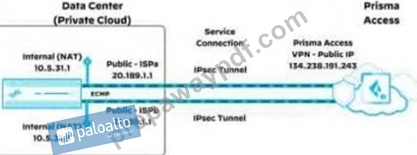
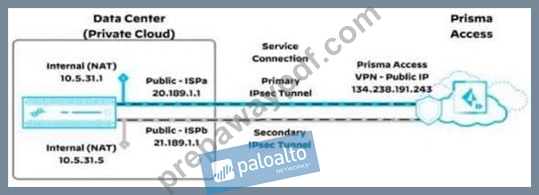
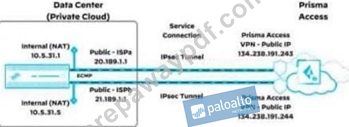
An organization is designing the Prisma Access service connections for its data centers. Each data center has 10 Gb redundant links to the internet. Each data center will need to support a minimum of 1.5 Gbps of throughput from Prisma Access connected users and branches. Which diagram depicts a solution that meets the requirements of this use case?
- A.
- B.
- C.

- D.
Answer: D
Explanation:
This design uses ECMP across redundant ISP links with multiple active IPsec tunnels, allowing traffic to be load-balanced and aggregated. This ensures the required throughput (>1.5 Gbps) can be achieved while also providing high availability and resilience, aligning with best practices for Prisma Access service connections.
NEW QUESTION # 51
A technology company is deploying its own AI applications on a Google Kubernetes Engine (GKE) cluster. The development team is concerned about protecting the complex, microservices- based AI stack from both internal and external threats: such as data poisoning and lateral movement between containerized components. Which solution should be proposed to address these concerns?
- A. Prisma AIRS API Intercept
- B. AI Access Security with App-ID Cloud Engine
- C. AI Access Security with Advanced URL Filtering
- D. Prisma AIRS Network Intercept
Answer: D
Explanation:
Network Intercept provides visibility and enforcement on east-west and north-south traffic within Kubernetes environments, allowing inspection of communications between microservices. This enables detection and prevention of threats such as lateral movement and data poisoning by analyzing runtime network behavior inside the AI application stack.
NEW QUESTION # 52
An organization wants to modernize its legacy branch architecture. The existing architecture is rigid, complex, and ill-suited for a cloud-first strategy, creating high operational costs and latency.
- The four core data centers are strategically located in Dallas, Toronto, London and Tokyo, and they are interconnected by a dedicated MPLS backbone providing reliable connectivity but incurring significant costs and offering limited bandwidth scalability.
- Branches rely on MPLS or site-to-site VPN to connect to the nearest geographical data center.
- All internet-bound traffic from the branches is backhauled to the data center egress firewalls.
This creates latency for SaaS applications and increases bandwidth strain on the MPLS links.
The organization requires a proposal for a new WAN architecture for branch connectivity with the goal of improving security posture and SaaS application access as well as supporting local internet breakout for all branch devices, including IoT.
Which two implementations will achieve the goal of modernizing the branch architecture?
(Choose two.)
- A. SASE with Prisma Access for remote networks and service connections
- B. SSE with Prisma Access for mobile users and service connections
- C. SD-WAN using on-premises NGFWs for Direct Internet Access (DIA)
- D. NGFW at each branch with Large Scale VPN (LSVPN) for data center access and Direct Internet Access (DIA)
Answer: A,C
Explanation:
SD-WAN using on-premises NGFWs for DIA modernizes branch connectivity by enabling secure local internet breakout at the branch instead of backhauling SaaS traffic through central data centers, which reduces latency and improves cloud application performance. Palo Alto Networks documents PAN-OS SD-WAN support for DIA and securing internet traffic either locally at the branch or through Prisma Access. IoT visibility is also supported at Prisma SD-WAN branch sites through ION devices, which aligns with the requirement to support all branch devices, including IoT.
SASE with Prisma Access for remote networks and service connections is the cloud-delivered architecture that secures branch offices through remote network connectivity while connecting back to enterprise resources through service connections. Palo Alto Networks describes Prisma Access as providing connectivity and security for remote branches, headquarters, data centers, and mobile users without requiring customers to build their own global security infrastructure, which directly supports a cloud-first branch modernization strategy.
NEW QUESTION # 53
You need to ensure consistent threat prevention across all applications. Which approach should you use?
- A. Use Security Profiles Group
- B. Apply profiles per application manually
- C. Disable inspection
- D. Use NAT rules
Answer: A
Explanation:
Security Profile Groups allow consistent application of multiple security profiles across policies.
This ensures standardized protection and simplifies management compared to applying profiles individually.
NEW QUESTION # 54
A company needs DNS-based threat protection to block malicious domains. Which solution is appropriate?
- A. URL Filtering
- B. App-ID
- C. QoS
- D. DNS Security
Answer: D
Explanation:
DNS Security detects and blocks malicious domains at the DNS layer, preventing communication with command-and-control servers. URL filtering works at a different layer and does not provide the same level of DNS-based protection.
NEW QUESTION # 55
An IoT sensor should be deployed in the path between the IoT device and which infrastructure component for comprehensive profiling coverage?
- A. SNMP Collector
- B. DHCP server
- C. DNS server
- D. IoT Gateway
Answer: B
Explanation:
DHCP traffic provides critical device-identifying attributes such as MAC address, hostname, vendor class identifier, and IP address assignment, which are essential for accurate IoT device profiling. Placing the IoT sensor in the path between the device and the DHCP server ensures comprehensive visibility during initial network onboarding, enabling reliable identification and classification.
NEW QUESTION # 56
An architect is reviewing a use case with the following requirements:
- Visibility on the health of an end user's path for the five most
critical applications
- Metrics on the impact of endpoint health for application
- Centralized call quality analytics from Zoom video conferencing
solution
- Insights into the supporting protocols, such as DNS
- Support 600 users on Windows desktops in a single sales office
Which solution should be recommended to meet these requirements?
- A. Remote networks with ADEM enabled and an ION device
- B. GlobalProtect with a Prisma Access portal configured and ADEM enabled
- C. Prisma SD-WAN using the native application dashboard and link quality monitoring
- D. Prisma Browser or the Prisma Browser extension with RUM metrics
Answer: A
Explanation:
ADEM with a remote network and an ION device is the best fit for a single office deployment because it provides end-to-end visibility for branch users and applications, including path monitoring for critical apps and insight into supporting services such as DNS. Palo Alto Networks also states that ADEM for remote sites is supported on Prisma SD-WAN remote sites with ION platforms, and ADEM's Zoom integration delivers centralized meeting quality analytics correlated with network and endpoint factors. This aligns with the requirement to monitor user experience for a 600-user Windows-based sales office from a centralized view.
NEW QUESTION # 57
A company wants automated response to detected threats. What should they implement?
- A. Manual response
- B. Static rules only
- C. SOAR integration
- D. Disable alerts
Answer: C
Explanation:
SOAR enables automated incident response by integrating detection and remediation workflows.
This reduces response time and improves consistency compared to manual processes.
NEW QUESTION # 58
......
Study HIGH Quality NetSec-Architect Free Study Guides and Exams Tutorials: https://www.prepawaypdf.com/Palo-Alto-Networks/NetSec-Architect-practice-exam-dumps.html
New NetSec-Architect Actual Exam Dumps, Palo Alto Networks Practice Test: https://drive.google.com/open?id=1HeIUlgMt6rEmLpvfdjvvcljw-2fQspdg