

[Nov-2025] CEM PDF Dumps Extremely Quick Way Of Preparation
Download CEM Dumps (2025) - Free PDF Exam Demo
NEW QUESTION # 66
An energy-saving project costs $540,000. The project will have maintenance costs of $25,000 per year. The energy savings from the project are $160,000 per year. What is the simple payback of the project?
- A. 4.0 years
- B. 3.0 years
- C. 2.0 years
- D. 5.0 years
Answer: A
Explanation:
To determine the simple payback period for the energy-saving project, we need to apply the standard formula used in energy management as per the Association of Energy Engineers (AEE) Certified Energy Manager (CEM) guidelines. The simple payback period is a widely used metric in energy efficiency projects to evaluate how long it takes for the initial investment to be recovered through net savings. Let's break this down step-by-step using the provided data and CEM-aligned methodology.
Step 1: Understand the Simple Payback Formula
* Formula: Simple Payback Period (years)=Initial Investment CostNet Annual Savings\text{Simple Payback Period (years)} = \frac{\text{Initial Investment Cost}}{\text{Net Annual Savings}} Simple Payback Period (years)=Net Annual SavingsInitial Investment Cost
* Definition: The simple payback period represents the time (in years) required for the cumulative savings to equal the initial investment, without considering the time value of money (e.g., discount rates or inflation).
* CEM Reference: AEE CEM training materials emphasize this formula in the "Energy Economics" section, where simple payback is a fundamental tool for assessing project feasibility.
Step 2: Identify Given Data
* Initial Investment Cost: $540,000 (one-time cost of the project).
* Annual Energy Savings: $160,000 per year (benefit from the project).
* Annual Maintenance Costs: $25,000 per year (additional cost incurred due to the project).
* Net Annual Savings: This must account for both the savings and the costs incurred annually.
Step 3: Calculate Net Annual Savings
* Definition: Net annual savings is the difference between the annual energy savings and any additional annual costs (e.g., maintenance).
* Verification: The problem specifies maintenance costs as an ongoing expense tied to the project, which reduces the effective savings. CEM guidelines require including such costs in payback calculations unless explicitly stated otherwise.
Step 4: Compute the Simple Payback Period
* Apply the Formula: Simple Payback Period=Initial Investment CostNet Annual Savings\text{Simple Payback Period} = \frac{\text{Initial Investment Cost}}{\text{Net Annual Savings}} Simple Payback Period=Net Annual SavingsInitial Investment Cost Simple Payback Period=540,
000135,000=4.0 years\text{Simple Payback Period} = \frac{540,000}{135,000} = 4.0 \, \text{years} Simple Payback Period=135,000540,000=4.0years
* Result: The payback period is exactly 4.0 years, meaning it takes 4 years for the net savings to recover the initial investment.
Step 5: Validate Against Options
* Options:A. 2.0 yearsB. 3.0 yearsC. 4.0 yearsD. 5.0 years
* Check:
* If we ignored maintenance costs (incorrectly), payback would be 540,000160,000=3.375 \frac
{540,000}{160,000} = 3.375 160,000540,000=3.375 years, which rounds to 3.4-not an exact match for any option.
* With maintenance costs included, 540,000135,000=4.0 \frac{540,000}{135,000} = 4.0
135,000540,000=4.0, which matches option C precisely.
* Conclusion: Option C (4.0 years) is correct based on the net savings approach.
NEW QUESTION # 67
In a PID control system, what is the purpose of the Proportional Gain?
- A. Reacts to change
- B. Senses high load rate
- C. Reduces/eliminates offset
- D. Control point
Answer: A
NEW QUESTION # 68
If installed without ancillary equipment, photovoltaic power cells generate what type of power?
- A. Sinusoidal alternating current
- B. Square-wave alternating current
- C. Direct current
Answer: C
NEW QUESTION # 69
A facility has the thermal cooling load profile shown in the table below. The utility rate traffic has an no-peak time-of-use period that begins at 10:00 a.m ends at 7:00 p.m. What chiller capacity (output) is required for a load-leveling operating strategy?
[Question from the previous image, which was about chiller capacity for load leveling, but the table was missing]
- A. 5.0 GJ/h
- B. 7.0 GJ/h
- C. 8.0 GJ/h
- D. 4.0 GJ/h
Answer: C
NEW QUESTION # 70
At the end of a performance contract, who owns the equipment installed by the project?
- A. The company that paid the contract payments
- B. The equipment manufacturer
- C. The bank
- D. The energy service company
Answer: A
NEW QUESTION # 71
Insulation has a thermal conductivity of 0.04 Watt/(m-°C). What is the R-value for this insulation when it is 5- cm thick?
- A. 20 Watt/(m²-°C)
- B. 0.8 (m²-°C)/Watt
- C. 2.20 Watt/m²
- D. 1.25 (m²-°C)/Watt
- E. 20 (m²-°C)/Watt
Answer: D
NEW QUESTION # 72
Which pump system listed below is most likely the best application for converting to variable-speed drive?
- A. Pump system with throttle fully open circulating liquid in a closed loop cooling system
- B. Pump system with bypass control transferring liquid from an intake dam to a process in production
- C. Pump system with on-off control transferring liquid vertically from a low tank to a higher tank
- D. Pump system with parallel rotary lobe pumps in a rebar quenching application with a static head of 80m
Answer: A
NEW QUESTION # 73
The set point for the chiller supply water temperature is varied as a function of the thermal demand for space cooling. What do you call this control strategy?
- A. Condenser-water temperature reset
- B. Reheat coil reset
- C. Night setback
- D. Chilled-water temperature reset
Answer: D
NEW QUESTION # 74
How can you tell if steam traps in a steam distribution system may NOT be working correctly?
- A. All of the above
- B. No sound from inverted bucket steam traps
- C. Rapid chattering of disk steam traps
- D. Robust flash steam rising from condensate receiver tank vent pipes
- E. An increase in make-up water requirements relative to steam demand
Answer: A
NEW QUESTION # 75
Using the natural gas combustion efficiency tables in your workbook, find the combustion efficiency (based on higher-heating value) of a natural-gas-fired boiler if the excess air level is measured at 31.9% and the stack temperature rise is 187.8°C.
- A. 78%
- B. 76%
- C. 82%
- D. 80%
- E. 84%
Answer: C
NEW QUESTION # 76
What type of passive heat exchanger can wrap around an evaporator coil to precool entering air and reheat the air after the cooling coil without adding more moisture to the supply air stream?
- A. Heat pipe
- B. Plate and frame
- C. Run-around coil
- D. Desiccant heat wheel
- E. Heat pump
Answer: A
NEW QUESTION # 77
The International Performance Measurement and Verification Protocol (IPMVP) has how many categories (method options) to determine the performance of an energy- or water-consuming system?
- A. 3 Options
- B. 2 Options
- C. 5 Options
- D. 6 Options
- E. 4 Options
Answer: E
NEW QUESTION # 78
What is a common cause of poor power quality?
- A. Incandescent lighting
- B. Synchronous motors
- C. Partially loaded induction motors
- D. Natural gas turbine power generation by utilities
- E. Electronic equipment, such as personal computers
Answer: E
NEW QUESTION # 79
How much fuel is required to heat 50 kg water from 20°C water to 200°C saturated steam? Assume the boiler is 80% efficient (based on the higher-heating value of the fuel).
- A. 127.2 MJ
- B. 169.3 MJ
- C. 210.5 MJ
- D. 511.2 MJ
Answer: B
NEW QUESTION # 80
According to ISO 50001. when performing internal audits on the energy management system in an organization the internal auditor should do which of the following?
SELECT THE CORRECT ANSWER
- A. All of the above
- B. Look for opportunities for energy improvement and to minimize bureaucracy inthe energy management system
- C. Review the written procedures related to the area under audit
- D. Focus on the areas of significant energy use
- E. Assess actual activities as practiced against what the written procedures state
Answer: A
Explanation:
When conducting internal audits of an Energy Management System (EnMS) in accordance with ISO 50001, auditors are expected to perform several key activities to ensure the system's effectiveness and continual improvement. These activities include:
* Focus on Areas of Significant Energy Use:Auditors should prioritize auditing areas that have substantial energy consumption, as improvements in these areas can lead to significant energy performance enhancements.
* Review Written Procedures Related to the Area Under Audit:A thorough examination of documented procedures ensures that they align with ISO 50001 requirements and organizational practices. This review helps in identifying any discrepancies between documented procedures and actual practices.
* Assess Actual Activities Against Written Procedures:Auditors compare on-ground activities with documented procedures to verify compliance and identify deviations. This assessment ensures that operations are performed as intended and in line with established protocols.
* Look for Opportunities for Energy Improvement and Minimize Bureaucracy:Identifying opportunities for enhancing energy performance is a core objective of the audit.Auditors should also aim to streamline the EnMS by reducing unnecessary complexities, thereby making it more efficient and user-friendly.
By encompassing all these activities, internal auditors ensure a comprehensive evaluation of the EnMS, leading to effective energy management and continual improvement. Therefore, the correct answer is E. All of the above.
NEW QUESTION # 81
A 25-kW motor, at full load, drives a centrifugal fan that produces 160,000 liters per second (l/s) of ventilation air. If the fan speed is reduced to a flow rate of 150,000 l/s, what is the new load on the motor?
- A. 20.6 kW
- B. 15.2 kW
- C. 30.3 kW
- D. 24.2 kW
- E. 25.0 kW
Answer: A
NEW QUESTION # 82
A 50-kW induction motor (1,500 rpm synchronous speed) has a nameplate full-load rotational speed of 1,455 rpm. Field measurements show the actual rotational speed is 1,475 rpm. Using the slip method, calculate the partial load factor of the motor.
- A. 46%
- B. 56%
- C. 80%
- D. 101%
- E. 98%
Answer: C
NEW QUESTION # 83
A steam trap with a 6-mm orifice in an 0.8-MPa steam system has failed open. The steam system is pressurized8.760 hours/yr. The steam cost is $15.00 /GJ. Using thetable below, what is the annualcost of the vented steam through the failed steam trap? ignore any condensate return issues.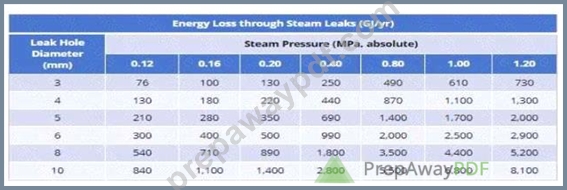
[The question from the previous image, which was about calculating the annual cost of heat loss through a wall, but had a discrepancy between the calculated cost and the provided answer choices]
- A. $30,000/yr
- B. $5,000/yr
- C. $40,000/yr
- D. $10,000/yr
- E. $20,000/yr
Answer: A
NEW QUESTION # 84
......
Enhance your career with CEM PDF Dumps - True AEE Exam Questions: https://www.prepawaypdf.com/AEE/CEM-practice-exam-dumps.html
New Download free CEM PDF for AEE Practice Tests: https://drive.google.com/open?id=1VkS5mHxp8AjtCpm6zUVmjZ2KuF_nd0iJ