

Latest Success Metrics For Actual CS0-003 Exam (Updated 668 Questions)
Genuine CS0-003 Exam Dumps Free Demo Valid QA's
The CompTIA Cybersecurity Analyst (CySA+) Certification Exam certification exam is designed to test a candidate's ability to perform cybersecurity analysis and respond to threats. It is a comprehensive exam that evaluates a candidate's knowledge of cybersecurity concepts, tools, and techniques. CS0-003 exam is composed of multiple-choice questions and performance-based questions. CS0-003 exam is computer-based and can be taken at any Pearson VUE testing center.
CompTIA CySA+ CS0-003 certification exam is an excellent way for cybersecurity professionals to validate their skills and knowledge. It is a globally recognized certification that demonstrates the candidate's ability to identify and mitigate cybersecurity threats. Candidates who pass the exam are well-prepared to pursue a career in cybersecurity or advance their existing skills to the next level.
NEW QUESTION # 225
Which of the following is the best framework for assessing how attackers use techniques over an infrastructure to exploit a target's information assets?
- A. OWASP Testing Guide
- B. Structured Threat Information Expression
- C. Diamond Model of Intrusion Analysis
- D. Open Source Security Testing Methodology Manual
Answer: C
Explanation:
The Diamond Model of Intrusion Analysis focuses on understanding the relationships between the adversary, their capabilities, infrastructure, and victim. It provides a structured approach to examining how attackers exploit information assets. According to CompTIA CySA+, this model is valuable for detailing attack patterns and understanding the infrastructure attackers use. The other options, like Structured Threat Information Expression (A) and OWASP Testing Guide (B), address threat data sharing and web application testing, respectively, while the Open Source Security Testing Methodology Manual (OSSTMM) (C) covers general security testing procedures.
NEW QUESTION # 226
A security program was able to achieve a 30% improvement in MTTR by integrating security controls into a SIEM. The analyst no longer had to jump between tools. Which of the following best describes what the security program did?
- A. Threat feed combination
- B. Single pane of glass
- C. Data enrichment
- D. Security control plane
Answer: B
Explanation:
A single pane of glass is a term that describes a unified view or interface that integrates multiple tools or data sources into one dashboard or console. A single pane of glass can help improve security operations by providing visibility, correlation, analysis, and alerting capabilities across various security controls and systems. A single pane of glass can also help reduce complexity, improve efficiency, and enhance decision making for security analysts. In this case, a security program was able to achieve a 30% improvement in MTTR by integrating security controls into a SIEM, which provides a single pane of glass for security operations.
NEW QUESTION # 227
A vulnerability management team is unable to patch all vulnerabilities found during their weekly scans. Using the third-party scoring system described below, the team patches the most urgent vulnerabilities: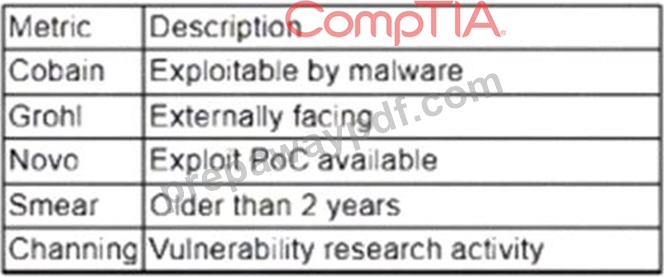
Additionally, the vulnerability management team feels that the metrics Smear and Channing are less important than the others, so these will be lower in priority. Which of the following vulnerabilities should be patched first, given the above third-party scoring system?
- A. TSpirit:
Cobain: Yes
Grohl: Yes
Novo: Yes
Smear: No
Channing: No - B. ENameless:
Cobain: Yes
Grohl: No
Novo: Yes
Smear: No
Channing: No - C. InLoud:
Cobain: Yes
Grohl: No
Novo: Yes
Smear: Yes
Channing: No - D. PBleach:
Cobain: Yes
Grohl: No
Novo: No
Smear: No
Channing: Yes
Answer: A
Explanation:
The vulnerability that should be patched first, given the above third-party scoring system, is:
TSpirit: Cobain: Yes Grohl: Yes Novo: Yes Smear: No Channing: No
This vulnerability has three out of five metrics marked as Yes, which indicates a high severity level. The metrics Cobain, Grohl, and Novo are more important than Smear and Channing, according to the vulnerability management team. Therefore, this vulnerability poses a greater risk than the other vulnerabilities and should be patched first.
NEW QUESTION # 228
A new cybersecurity analyst is tasked with creating an executive briefing on possible threats to the organization. Which of the following will produce the data needed for the briefing?
- A. Firewall logs
- B. Indicators of compromise
- C. Risk assessment
- D. Access control lists
Answer: B
Explanation:
Indicators of compromise (IoCs) are pieces of data or evidence that suggest a system or network has been compromised by an attacker or malware. IoCs can include IP addresses, domain names, URLs, file hashes, registry keys, network traffic patterns, user behaviors, or system anomalies. IoCs can be used to detect, analyze, and respond to security incidents, as well as to share threat intelligence with other organizations or authorities. IoCs can produce the data needed for an executive briefing on possible threats to the organization, as they can provide information on the source, nature, scope, impact, and mitigation of the threats.
NEW QUESTION # 229
An analyst views the following log entries:
The organization has a partner vendor with hosts in the 216.122.5.x range. This partner vendor is required to have access to monthly reports and is the only external vendor with authorized access. The organization prioritizes incident investigation according to the following hierarchy:
- unauthorized data disclosure is more critical than denial of service
attempts.
- which are more important than ensuring vendor data access.
Based on the log files and the organization's priorities, which of the following hosts warrants additional investigation?
- A. 121.19.30.221
- B. 202.180.1582
- C. 216.122.5.5
- D. 134.17.188.5
Answer: A
NEW QUESTION # 230
An analyst is reviewing a vulnerability report for a server environment with the following entries: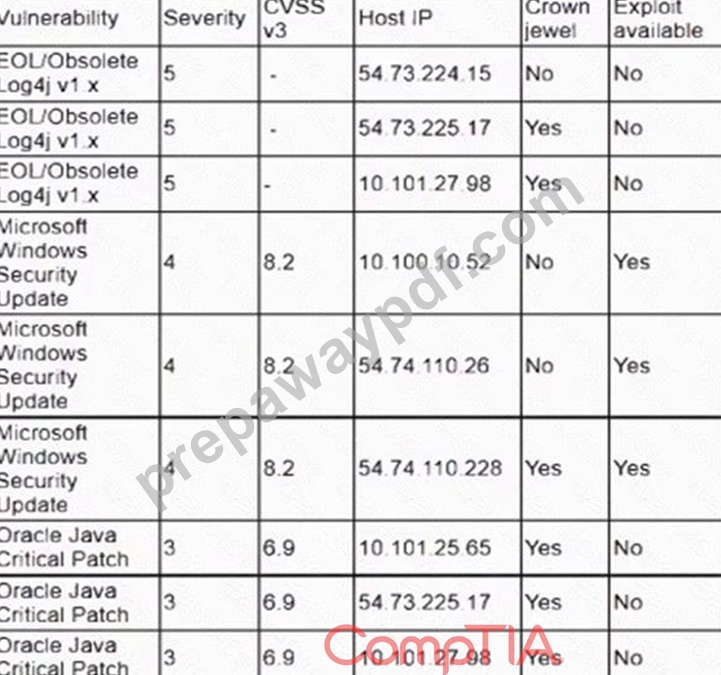
Which of the following systems should be prioritized for patching first?
- A. 54.73.225.17
- B. 10.101.27.98
- C. 54.74.110.26
- D. 54.74.110.228
Answer: D
Explanation:
The system that should be prioritized for patching first is 54.74.110.228, as it has the highest number and severity of vulnerabilities among the four systems listed in the vulnerability report. According to the report, this system has 12 vulnerabilities, with 8 critical, 3 high, and 1 medium severity ratings. The critical vulnerabilities include CVE-2019-0708 (BlueKeep), CVE-2019-1182 (DejaBlue), CVE-2017-0144 (EternalBlue), and CVE-2017-0145 (EternalRomance), which are all remote code execution vulnerabilities that can allow an attacker to compromise the system without any user interaction or authentication. These vulnerabilities pose a high risk to the system and should be patched as soon as possible.
NEW QUESTION # 231
Which of the following risk management principles is accomplished by purchasing cyber insurance?
- A. Mitigate
- B. Transfer
- C. Avoid
- D. Accept
Answer: B
Explanation:
Transfer is the risk management principle that is accomplished by purchasing cyber insurance. Transfer is a strategy that involves shifting the risk or its consequences to another party, such as an insurance company, a vendor, or a partner. Transfer does not eliminate the risk, but it reduces the potential impact or liability of the risk for the original party. Cyber insurance is a type of insurance that covers the losses and damages resulting from cyberattacks, such as data breaches, ransomware, denial-of-service attacks, or network disruptions. Cyber insurance can help transfer the risk of cyber incidents by providing financial compensation, legal assistance, or recovery services to the insured party. Official References:
https://partners.comptia.org/docs/default-source/resources/comptia-cysa-cs0-002-exam-objectives
https://www.comptia.org/certifications/cybersecurity-analyst
https://www.comptia.org/blog/the-new-comptia-cybersecurity-analyst-your-questions-answered
NEW QUESTION # 232
A systems administrator notices unfamiliar directory names on a production server. The administrator reviews the directory listings and files, and then concludes the server has been compromised. Which of the following steps should the administrator take next?
- A. Review the lessons learned for the best approach.
- B. Determine when the access started.
- C. Follow the company's incident response plan.
- D. Inform the internal incident response team.
Answer: C
Explanation:
An incident response plan is a set of predefined procedures and guidelines that an organization follows when faced with a security breach or attack. An incident response plan helps to ensure that the organization can quickly and effectively contain, analyze, eradicate, and recover from the incident, as well as prevent or minimize the damage and impact to the business operations, reputation, and customers. An incident response plan also defines the roles and responsibilities of the incident response team, the communication channels and protocols, the escalation and reporting procedures, and the tools and resources available for the incident response.
By following the company's incident response plan, the administrator can ensure that they are following the best practices and standards for handling a security incident, and that they are coordinating and collaborating with the relevant stakeholders and authorities. Following the company's incident response plan can also help to avoid or reduce any legal, regulatory, or contractual liabilities or penalties that may arise from the incident.
The other options are not as effective or appropriate as following the company's incident response plan. Informing the internal incident response team (A) is a good step, but it should be done according to the company's incident response plan, which may specify who, when, how, and what to report. Reviewing the lessons learned for the best approach is a good step, but it should be done after the incident has been resolved and closed, not during the active response phase. Determining when the access started (D) is a good step, but it should be done as part of the analysis phase of the incident response plan, not before following the plan.
NEW QUESTION # 233
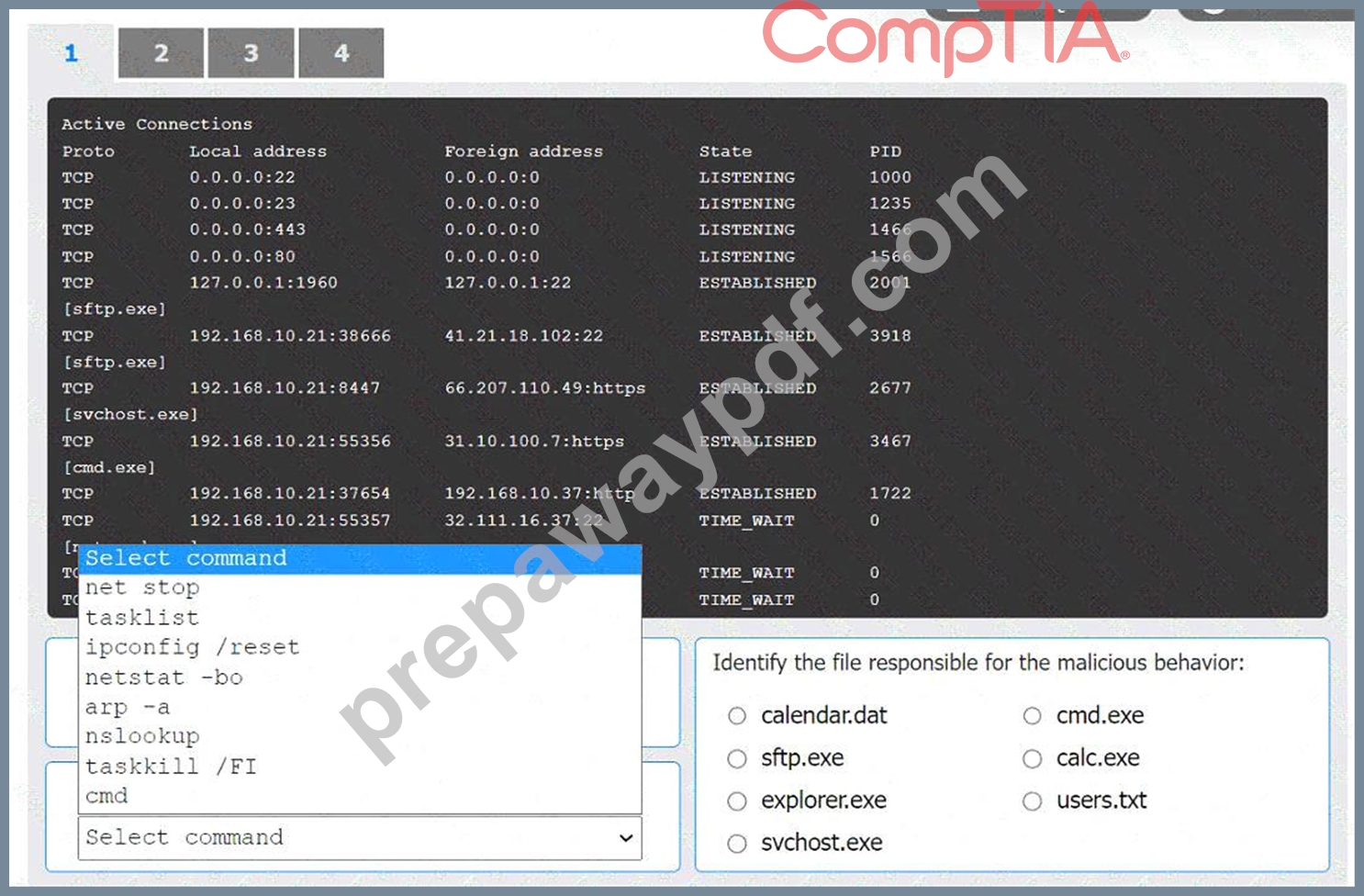
An organization has noticed large amounts of data are being sent out of its network. An analyst is identifying the cause of the data exfiltration.
INSTRUCTIONS
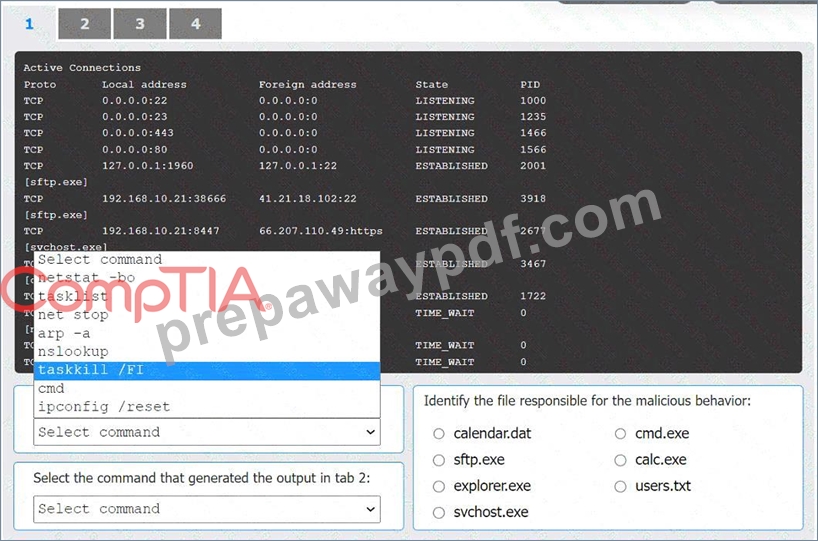
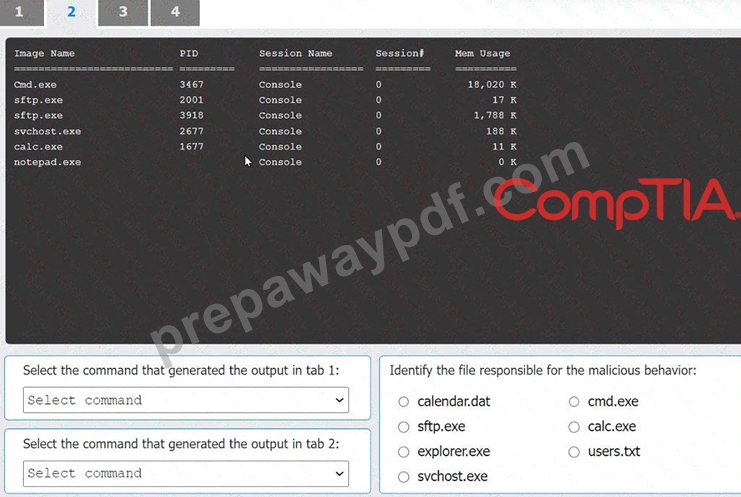
Select the command that generated the output in tabs 1 and 2.
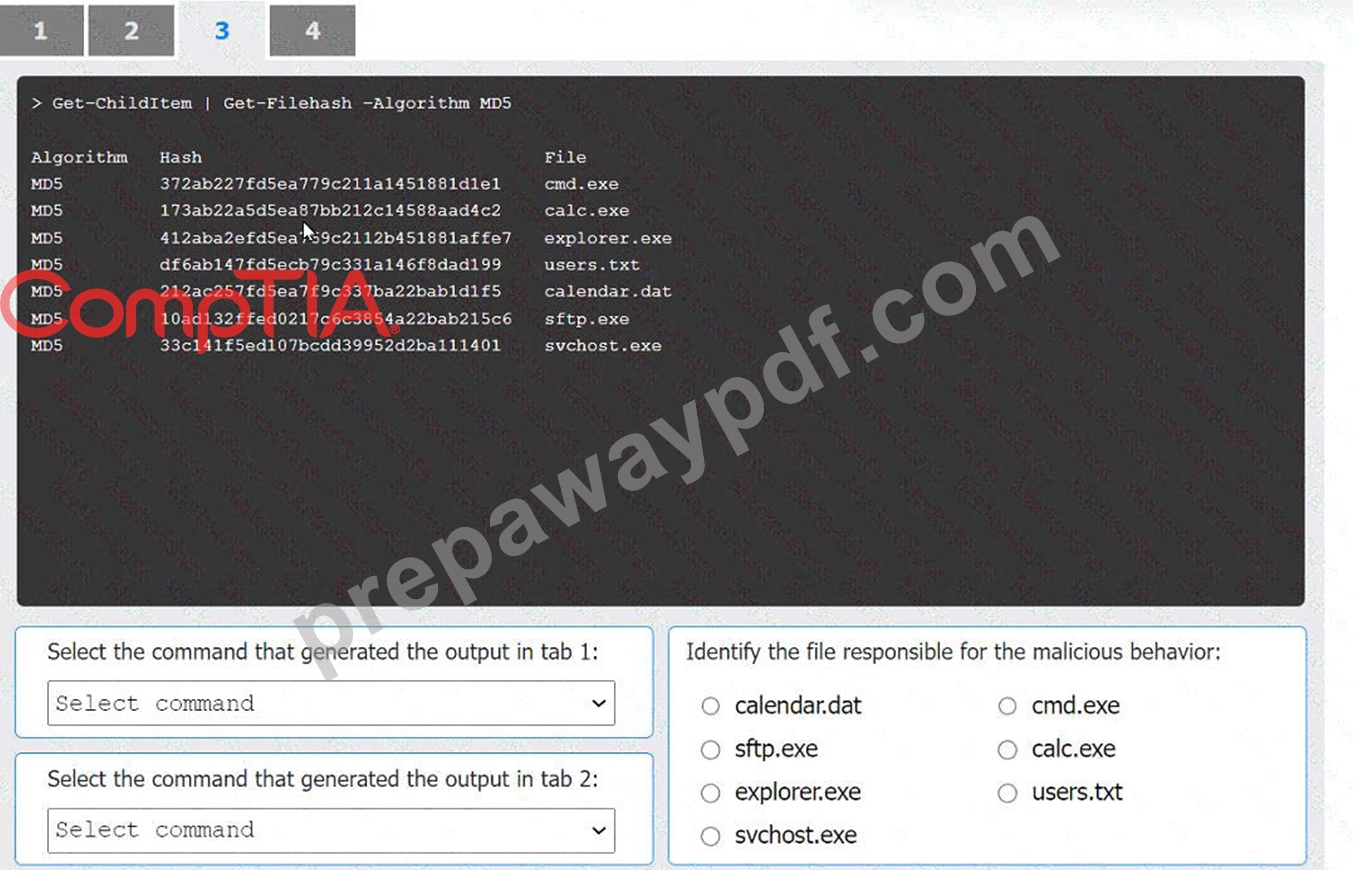
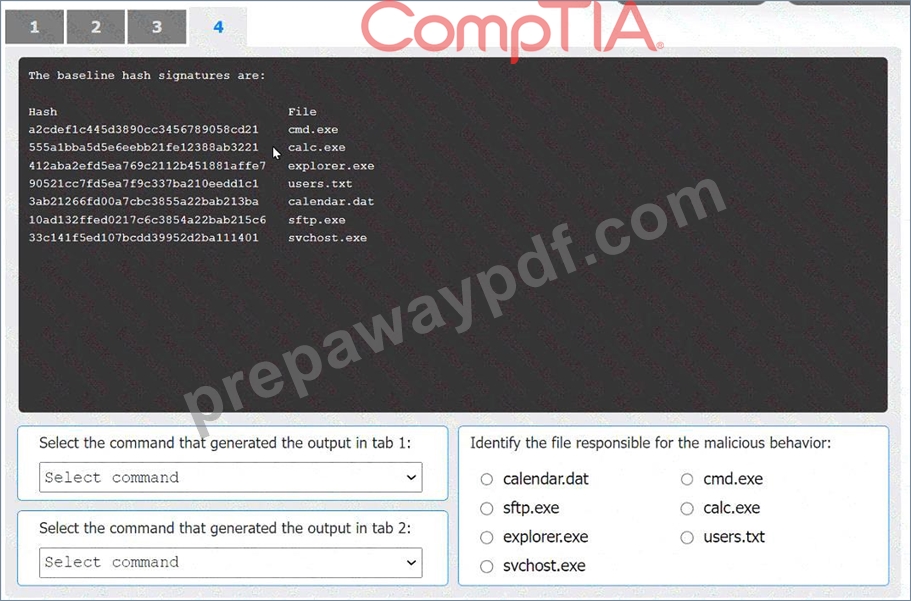
Review the output text in all tabs and identify the file responsible for the malicious behavior.
If at any time you would like to bring back the initial state of the simulation, please click the Reset All button.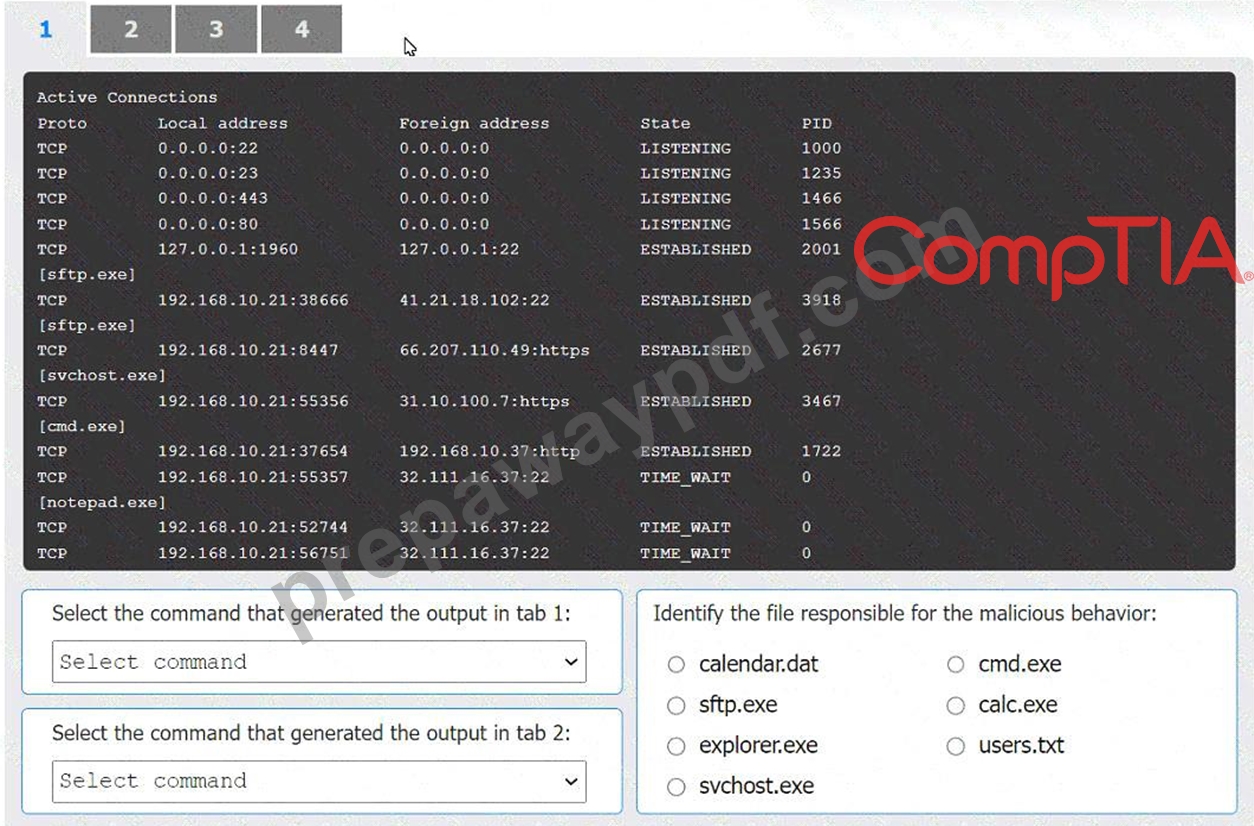
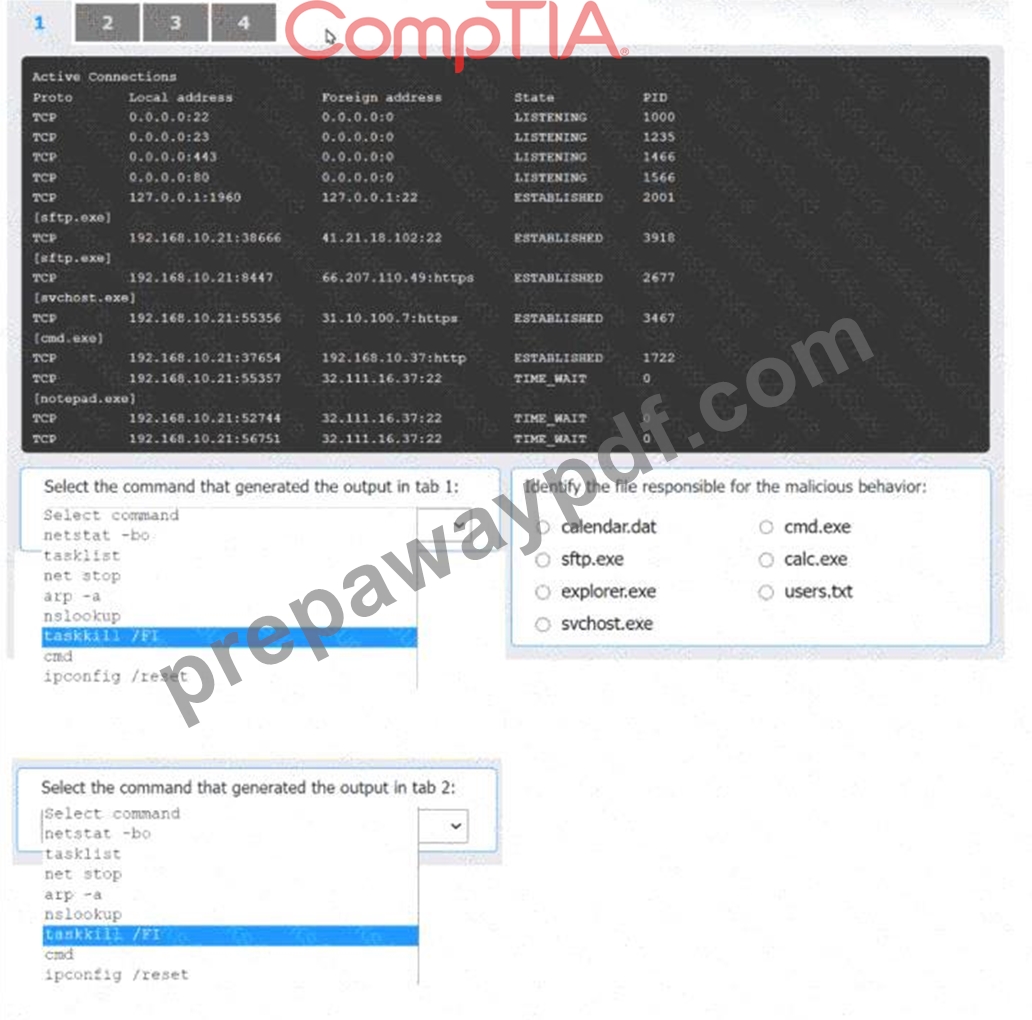
Answer:
Explanation: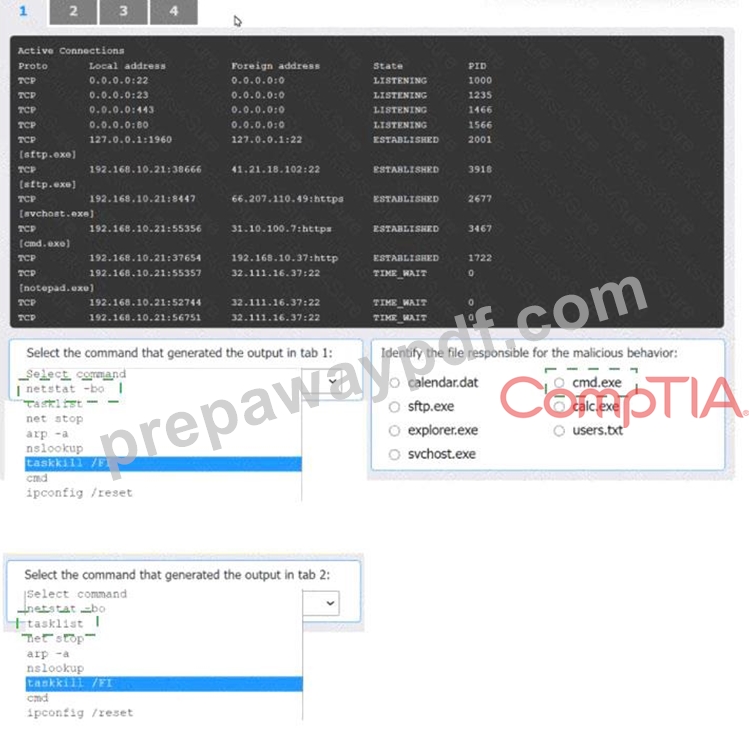
Explanation:
Select the command that generated the output in tab 1:
* netstat -bo
Select the command that generated the output in tab 2:
* tasklist
Identify the file responsible for the malicious behavior:
* cmd.exe
Select the command that generated the output in tab 1: The output in tab 1 displays active network connections, which can be generated using the netstat command with options to display the owning process ID.
Select the command that generated the output in tab 1:
* netstat -bo
Select the command that generated the output in tab 2: The output in tab 2 lists the running processes with their PIDs and memory usage, which can be generated using the tasklist command.
Select the command that generated the output in tab 2:
* tasklist
Identify the file responsible for the malicious behavior: To identify the malicious file, we compare the hashes of the current files against the baseline hashes. From the provided data:
* The hash for cmd.exe in the current state (tab 3) is 372ab227fd5ea779c211a1451881d1e1.
* The baseline hash for cmd.exe (tab 4) is a2cdef1c445d3890cc3456789058cd21.
Since these hashes do not match, cmd.exe is the file responsible for the malicious behavior.
NEW QUESTION # 234
An analyst is reviewing a dashboard from the company's SIEM and finds that an IP address known to be malicious can be tracked to numerous high-priority events in the last two hours. The dashboard indicates that these events relate to TTPs. Which of the following is the analyst most likely using?
- A. OWASP
- B. OSSTMM
- C. MITRE ATT&CK
- D. Diamond Model of Intrusion Analysis
Answer: C
Explanation:
The MITRE ATT&CK framework is widely used for tracking and categorizing Tactics, Techniques, and Procedures (TTPs) of adversaries. TTPs help analysts understand the behaviors and methods attackers employ during incidents, making this framework particularly useful in SIEM dashboards for correlating and identifying threats. While the other options (OSSTMM, Diamond Model, OWASP) offer various security methodologies, MITRE ATT&CK is specifically focused on documenting adversary behaviors, making it the best fit here. CompTIA CySA+ often emphasizes MITRE ATT&CK for mapping and understanding threat behaviors in incident response.
NEW QUESTION # 235
An organization has implemented code into a production environment. During a routine test, a penetration tester found that some of the code had a backdoor implemented, causing a developer to make changes outside of the change management windows. Which of the following is the best way to prevent this issue?
- A. Debugging
- B. SDLC training
- C. Source code review
- D. Dynamic analysis
Answer: C
Explanation:
* A backdoor is a deliberate vulnerability inserted into the code, often allowing unauthorized access.
* Source code review (Option D) is the best way to detect malicious code before it is deployed to production.
* SDLC training (Option A) is helpful but does not directly prevent the insertion of backdoors.
* Dynamic analysis (Option B) detects vulnerabilities at runtime but may not always identify backdoors in code.
* Debugging (Option C) is useful for troubleshooting but does not address security vulnerabilities.
# Reference: CompTIA CySA+ CS0-003 Official Study Guide, Secure Software Development Practices.
NEW QUESTION # 236
An organization conducted a web application vulnerability assessment against the corporate website, and the following output was observed: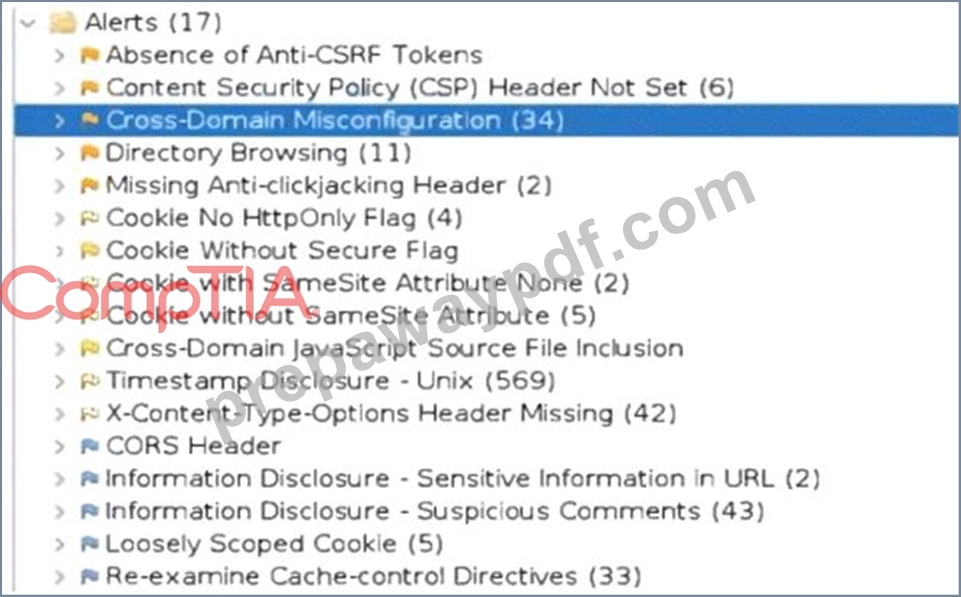
Which of the following tuning recommendations should the security analyst share?
- A. Set an HttpOnlvflaq to force communication by HTTPS
- B. Block requests without an X-Frame-Options header
- C. Configure an Access-Control-Allow-Origin header to authorized domains
- D. Disable the cross-origin resource sharing header
Answer: B
Explanation:
The output shows that the web application is vulnerable to clickjacking attacks, which allow an attacker to overlay a hidden frame on top of a legitimate page and trick users into clicking on malicious links. Blocking requests without an X-Frame-Options header can prevent this attack by instructing the browser to not display the page within a frame.
NEW QUESTION # 237
Approximately 100 employees at your company have received a Phishing email. AS a security analyst. you have been tasked with handling this Situation.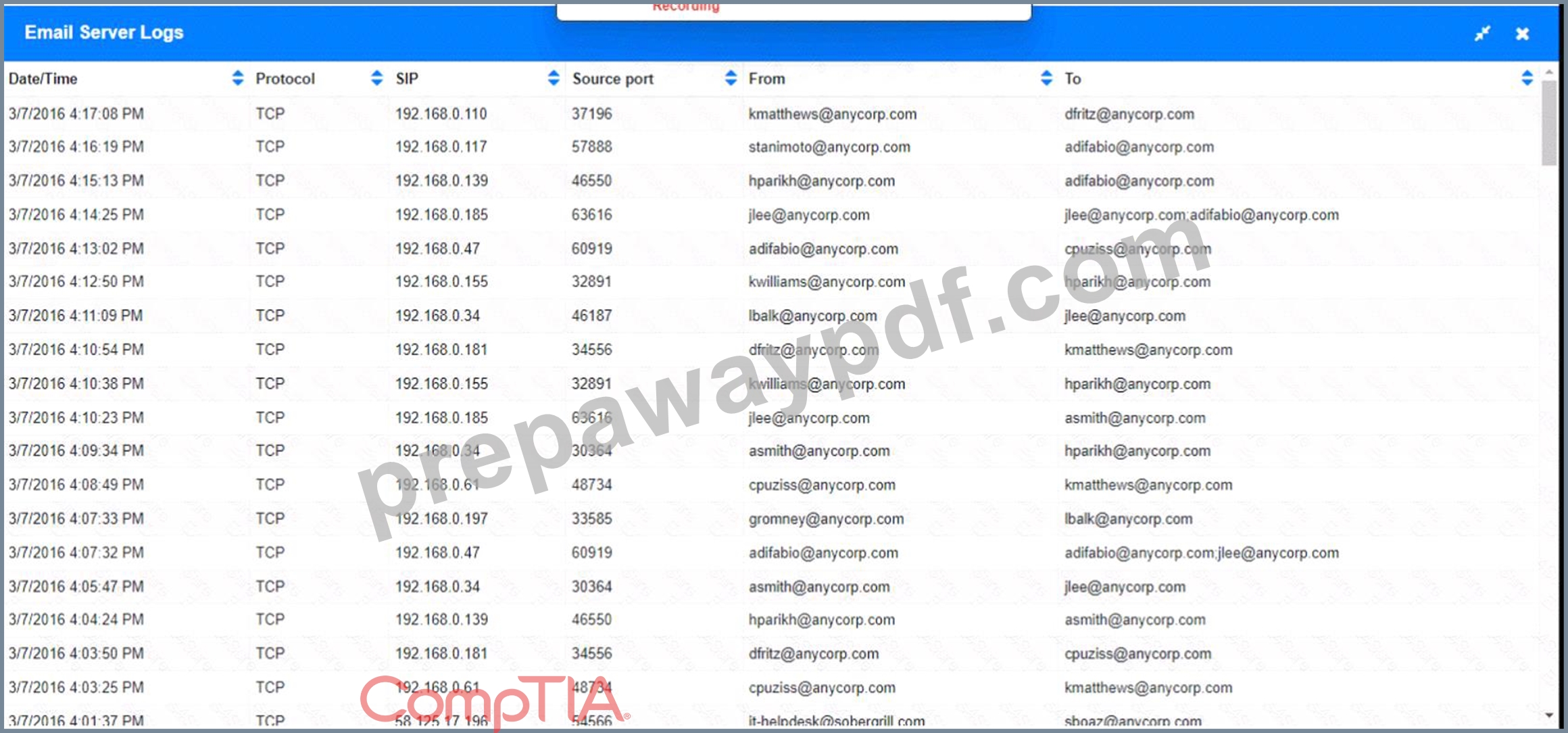
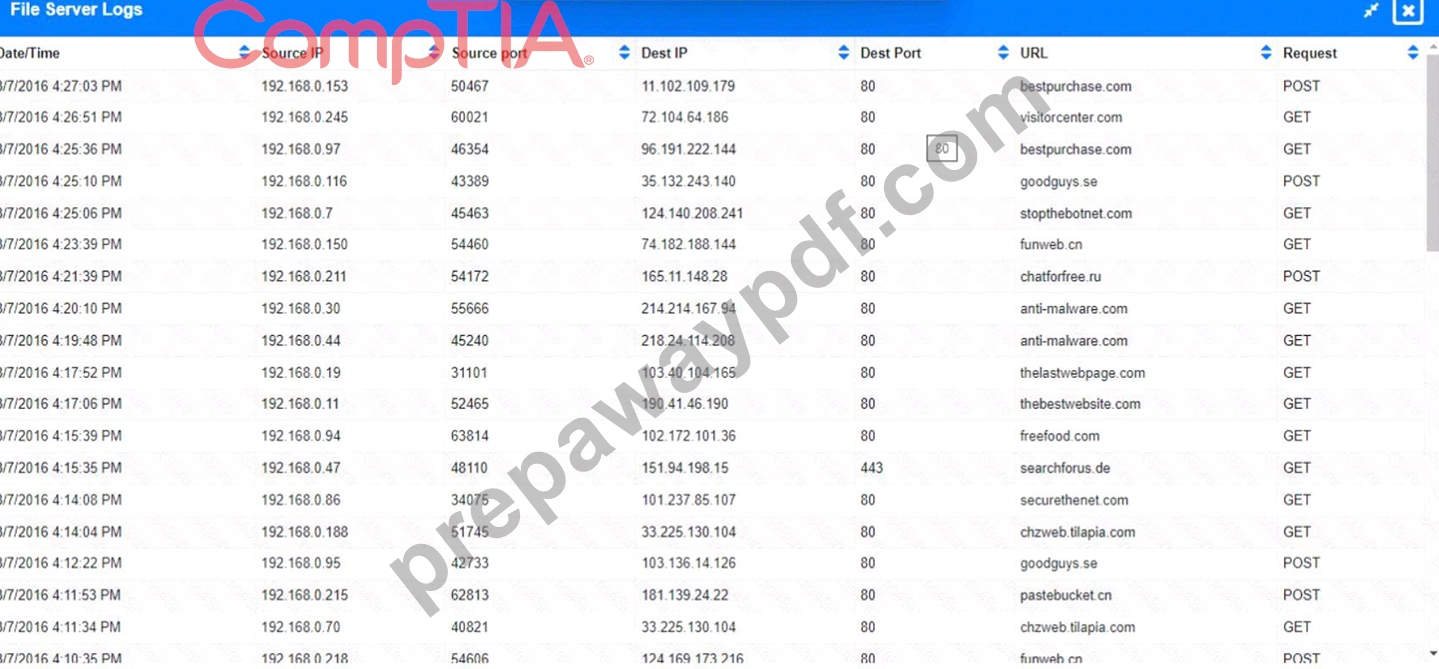
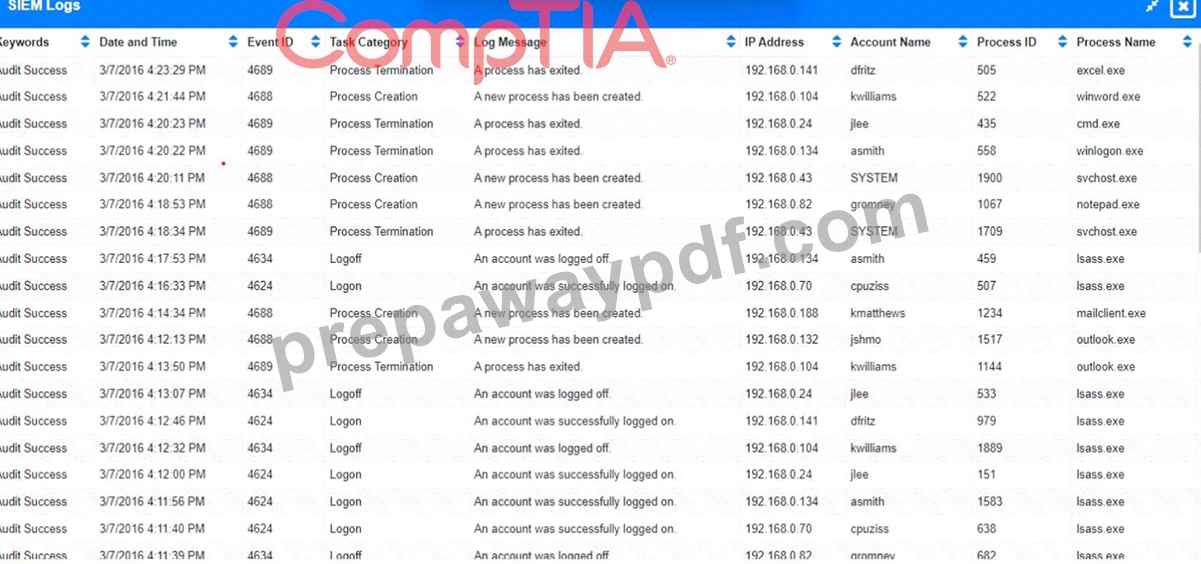
Review the information provided and determine the following:
1. HOW many employees Clicked on the link in the Phishing email?
2. on how many workstations was the malware installed?
3. what is the executable file name of the malware?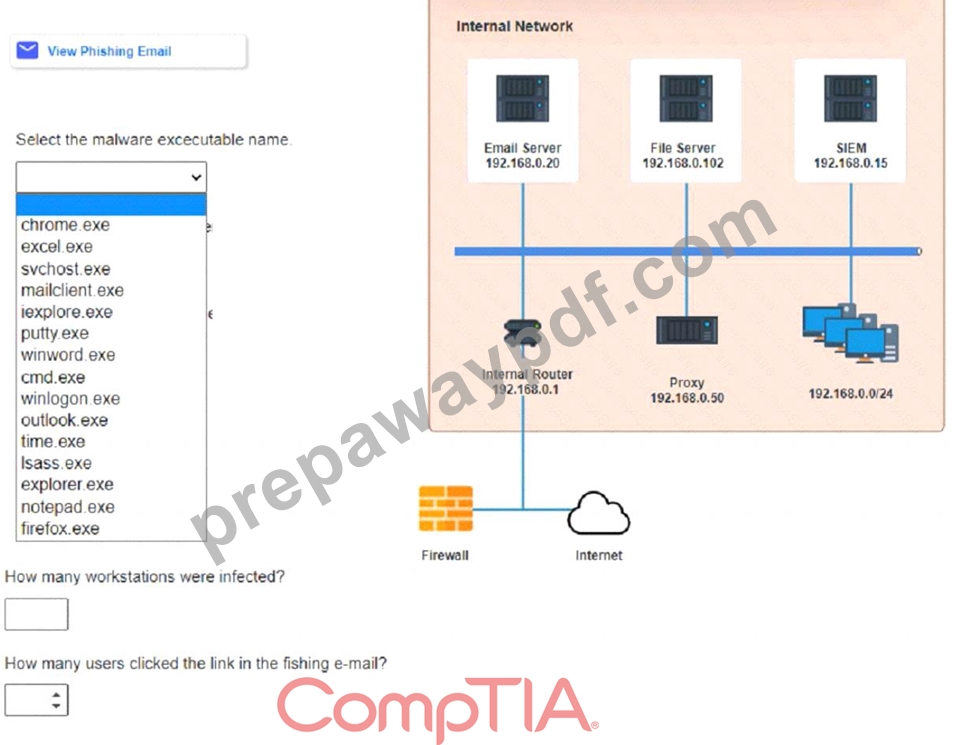
Answer:
Explanation:
see the answer in explanation for this task.
Explanation:
1. How many employees clicked on the link in the phishing email?
According to the email server logs, 25 employees clicked on the link in the phishing email.
2. On how many workstations was the malware installed?
According to the file server logs, the malware was installed on 15 workstations.
3. What is the executable file name of the malware?
The executable file name of the malware is svchost.EXE.
Answers
1. 25
2. 15
3. svchost.EXE
NEW QUESTION # 238
A company brings in a consultant to make improvements to its website. After the consultant leaves. a web developer notices unusual activity on the website and submits a suspicious file containing the following code to the security team: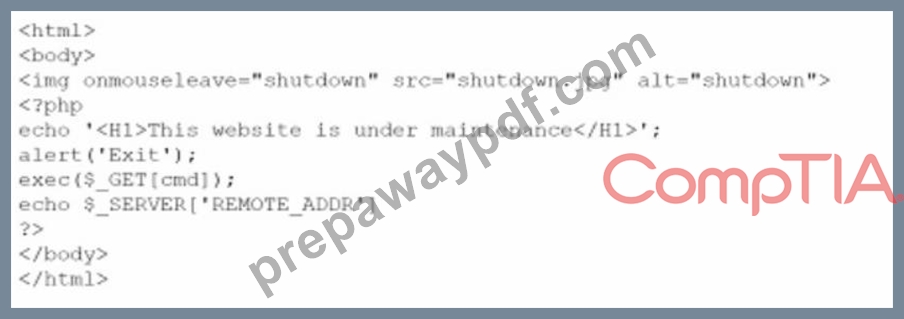
Which of the following did the consultant do?
- A. Patched the web server
- B. Implemented privilege escalation
- C. Implemented clickjacking
- D. Implanted a backdoor
Answer: D
Explanation:
The correct answer is A. Implanted a backdoor.
A backdoor is a method that allows an unauthorized user to access a system or network without the permission or knowledge of the owner. A backdoor can be installed by exploiting a software vulnerability, by using malware, or by physically modifying the hardware or firmware of the device. A backdoor can be used for various malicious purposes, such as stealing data, installing malware, executing commands, or taking control of the system.
In this case, the consultant implanted a backdoor in the website by using an HTML and PHP code snippet that displays an image of a shutdown button and an alert message that says "Exit". However, the code also echoes the remote address of the server, which means that it sends the IP address of the visitor to the attacker. This way, the attacker can identify and target the visitors of the website and use their IP addresses to launch further attacks or gain access to their devices.
The code snippet is an example of a clickjacking attack, which is a type of interface-based attack that tricks a user into clicking on a hidden or disguised element on a webpage. However, clickjacking is not the main goal of the consultant, but rather a means to implant the backdoor. Therefore, option C is incorrect.
Option B is also incorrect because privilege escalation is an attack technique that allows an attacker to gain higher or more permissions than they are supposed to have on a system or network. Privilege escalation can be achieved by exploiting a software vulnerability, by using malware, or by abusing misconfigurations or weak access controls. However, there is no evidence that the consultant implemented privilege escalation on the website or gained any elevated privileges.
Option D is also incorrect because patching is a process of applying updates to software to fix errors, improve performance, or enhance security. Patching can prevent or mitigate various types of attacks, such as exploits, malware infections, or denial-of-service attacks. However, there is no indication that the consultant patched the web server or improved its security in any way.
NEW QUESTION # 239
Which of the following security operations tasks are ideal for automation?
- A. Firewall IoC block actions:
Examine the firewall logs for IoCs from the most recently published zero-day exploit Take mitigating actions in the firewall to block the behavior found in the logs Follow up on any false positives that were caused by the block rules - B. Security application user errors:
Search the error logs for signs of users having trouble with the security application Look up the user's phone number Call the user to help with any questions about using the application - C. Email header analysis:
Check the email header for a phishing confidence metric greater than or equal to five Add the domain of sender to the block list Move the email to quarantine - D. Suspicious file analysis:
Look for suspicious-looking graphics in a folder.
Create subfolders in the original folder based on category of graphics found.
Move the suspicious graphics to the appropriate subfolder
Answer: C
Explanation:
Email header analysis is one of the security operations tasks that are ideal for automation. Email header analysis involves checking the email header for various indicators of phishing or spamming attempts, such as sender address spoofing, mismatched domains, suspicious subject lines, or phishing confidence metrics. Email header analysis can be automated using tools or scripts that can parse and analyze email headers and take appropriate actions based on predefined rules or thresholds
NEW QUESTION # 240
A manufacturer has hired a third-party consultant to assess the security of an OT network that includes both fragile and legacy equipment. Which of the following must be considered to ensure the consultant does no harm to operations?
- A. Running scans during off-peak manufacturing hours
- B. Using passive instead of active vulnerability scans
- C. Preserving the state of PLC ladder logic prior to scanning
- D. Employing Nmap Scripting Engine scanning techniques
Answer: B
Explanation:
In environments with fragile and legacy equipment, passive scanning is preferred to prevent any potential disruptions that active scanning might cause.
When assessing the security of an Operational Technology (OT) network, especially one with fragile and legacy equipment, it's crucial to use passive instead of active vulnerability scans.
Active scanning can sometimes disrupt the operation of sensitive or older equipment. Passive scanning listens to network traffic without sending probing requests, thus minimizing the risk of disruption.
NEW QUESTION # 241
A vulnerability management team found four major vulnerabilities during an assessment and needs to provide a report for the proper prioritization for further mitigation. Which of the following vulnerabilities should have the highest priority for the mitigation process?
- A. A vulnerability that is related to a specific adversary campaign, with loCs found in the SIEM
- B. A vulnerability that is related to an isolated system, with no loCs
- C. A vulnerability that has related threats and loCs, targeting a different industry
- D. A vulnerability that has no adversaries using it or associated loCs
Answer: A
Explanation:
A vulnerability that is related to a specific adversary campaign, with IoCs found in the SIEM, should have the highest priority for the mitigation process. This is because it indicates that the vulnerability is actively being exploited by a known threat actor, and that the organization's security monitoring system has detected signs of compromise. This poses a high risk of data breach, service disruption, or other adverse impacts.
References: How to Prioritize Vulnerabilities Effectively: Vulnerability Prioritization Explained, Section:
How to prioritize vulnerabilities step by step to avoid drowning in sea of problems; CompTIA CySA+ Study Guide: Exam CS0-003, 3rd Edition, Chapter 4: Security Operations and Monitoring, page 156.
NEW QUESTION # 242
The analyst reviews the following endpoint log entry:
Which of the following has occurred?
- A. Registry change
- B. New account introduced
- C. Privilege escalation
- D. Rename computer
Answer: B
Explanation:
The endpoint log entry shows that a new account named "admin" has been created on a Windows system with a local group membership of "Administrators". This indicates that a new account has been introduced on the system with administrative privileges. This could be a sign of malicious activity, such as privilege escalation or backdoor creation, by an attacker who has compromised the system.
NEW QUESTION # 243
Which of the following best explains the importance of security orchestration, automation, and response for security operation activities?
- A. Implementing infrastructure as code in the organization
- B. Collecting threat intelligence feeds for improved threat response
- C. Deploying general scripts for automating security engineering operations
- D. Supporting the team's management of remediation tasks
Answer: A
Explanation:
Security orchestration, automation, and response streamlines and coordinates incident response workflows, enabling the SOC team to efficiently manage, prioritize, and execute remediation tasks at scale.
NEW QUESTION # 244
......
CompTIA CS0-003, also known as the CompTIA Cybersecurity Analyst (CySA+) Certification exam, is a globally recognized certification designed to validate the skills and knowledge required to perform intermediate-level cybersecurity analysis. CompTIA Cybersecurity Analyst (CySA+) Certification Exam certification helps IT professionals to advance their career in cybersecurity by demonstrating their expertise in identifying and addressing security threats and vulnerabilities.
CS0-003 Practice Test Give You First Time Success with 100% Money Back Guarantee!: https://www.prepawaypdf.com/CompTIA/CS0-003-practice-exam-dumps.html
Printable & Easy to Use CompTIA Cybersecurity Analyst CS0-003 Dumps 100% Same Q&A In Your Real Exam: https://drive.google.com/open?id=1_fkVwzEmCLBpUQ2y8CSwEOPpzCz5NX0n