

[Apr-2024] HP HPE7-A07 Exam Practice Test Questions - PrepAwayPDF
Updated Certification Exam HPE7-A07 Dumps - Practice Test Questions
NEW QUESTION # 19
Exhibit.
Which wireless connection phase has Just been completed?
- A. L2 authentication and encryption
- B. 802.11 enhanced open association
- C. L3 authentication and encryption
- D. MAC Authentication and 4-way handshake
Answer: A
Explanation:
The wireless connection phase that has just been completed is L2 authentication and encryption. This phase includes processes such as the Extensible Authentication Protocol (EAP) exchange, RADIUS requests and responses, and the 4-way handshake which is characteristic of WPA2-AES encryption.
NEW QUESTION # 20
A university owns a campus with several buildings segmented into east and west wings, which are L3 separated. The east wing has 1600 APs. and the west wing has 1200 Aps. Each wing has a single gateway cluster managed by HPE Aruba Networking Central. Each cluster contains one 7210 mobility gateway The gateways are configured with DHCP relay and route all client VLANs. A new business-critical facultyreal-time application requires users to roam within wings but not across wings without disconnections or delay increments.
Which changes must the network administrator make lo successfully meet the requirement without performance degradation matching best practices? (Select two.)
- A. Add a single 7210 mobility gateway to each cluster.
- B. Remove the DHCP relay from the gateways and enable the DHCP server instead
- C. Run L2 for all SSIDs and permit the users' VLANs in the gateway's uplinks.
- D. Replace me 7210 mobility gateway in the east wing with a pair or 9012 mobility gateways
- E. Replace the 7210 mobility gateway in the west wing with a pair of 7030 mobility gateways.
Answer: A,C
Explanation:
To support a business-critical faculty real-time application that requires seamless roaming within wings without cross-wing roaming, it's essential to ensure high availability and sufficient capacity. Adding an additional 7210 mobility gateway to each cluster would provide the required redundancy and capacity.
Running L2 for all SSIDs and permitting user VLANs on gateway uplinks would facilitate the necessary traffic flow without L3 segmentation issues, thus supporting seamless roaming within each wing.
NEW QUESTION # 21
Exhibit.
A customer is reporting mat connectivity is Tailing for some wireless client Devices. What are your conclusions from the capture? (Select two.)
- A. The client is not receiving an IP address.
- B. The network is using WPA2-PSK key management.
- C. The client does not have an ARP entry for me default gateway.
- D. The client does not support beamforming.
- E. The network is using WPA3-SAE key management.
Answer: A,B
Explanation:
The capture shows messages related to WPA key management, indicating WPA2-PSK is being used. Also, the capture includes a DHCP request from the client but no corresponding DHCP ACK, suggesting the client is not receiving an IP address, which could explain the connectivity failure.
NEW QUESTION # 22
You configured" a bridgedmode SSID with WPA3-Enterprise and EAP-TLS security. When you connect an Active Directory joined client that has valid client certificates. ClearPass shows the following error.
What is needed to resolve this issue?
- A. Enable authorization in your Authentication Method.
- B. Configure ClearPass to trust the client certificate.
- C. Modify your ACX-AD authentication source to include the UPN in the search.
- D. Recreate the SSID m tunneled mode.
Answer: C
Explanation:
The error message "User not found" indicates that the authentication source, in this case, Active Directory (AD), is not able to locate the user account based on the current search parameters. This often occurs when the User Principal Name (UPN) that the client is using to authenticate is not included in the search parameters of the AD authentication source within ClearPass. By modifying the AD authentication source to include the UPN in the search, ClearPass will be able to correctly locate the user account and proceed with the authentication using the valid client certificates.
NEW QUESTION # 23
Based on best practices if an SSID is configured Tor a primary and secondary gateway cluster with cluster preemption enabled, which will decide if the APs move to the secondary gateway cluster if all of the nodes in the primary gateway cluster are down?
- A. cluster leader in the primary gateway cluster
- B. tunnel orchestrator for LAN tunnel service in HPE Aruba Networking Central
- C. every AP individually
- D. cluster leader in the secondary gateway cluster
Answer: C
Explanation:
In an Aruba network, if an SSID is configured for a primary and secondary gateway cluster with cluster preemption enabled, each AP individually will decide to move to the secondary gateway cluster if all of the nodes in the primary gateway cluster are down. This decentralized decision-making process enhances network resilience and ensures uninterrupted service for clients connected to the APs.
NEW QUESTION # 24
You configured a WPA3-SAE with the following MAC Authentication Role Mapping inCloud Authentication and Policy:
With further default settings assume a new Android phone is connected to the network. Which role will the client be assigned after connecting forthe first time?
- A. lot-local
- B. byod
- C. client will be rejected network access
- D. unmatched-device
Answer: D
Explanation:
The configuration shown in the third exhibit details a client role mapping that associates different client profile tags with specific client roles. When a new device, such as an Android phone, connects to the network, it will be profiled and assigned a role based on the mappings defined. If the device does not match any predefined profiles, it would be assigned the "unmatched-device" role. This is under the assumption that default settings are in place and the client does not match the criteria for any of the specific roles like "byod", "iot-internet", or
"iot-local". Therefore, an Android phone connecting for the first time and not matching any specific profile tag would be assigned to the "unmatched-device" role.
NEW QUESTION # 25
After onboarding three new AOS 10 gateways using the full-setup methodinto the same Central group, a customer cannot log in to one of the gateways using the HPE Aruba Networking Central remote console due to an incorrect password.
- A. The admin password created using full-setup does not match the global Central admin password.
- B. The admin password created during the run-setup process is not configured to allow me remote console access
- C. The admin password created at the Central group level has expired
- D. The admin password created during the full-setup process does not match the Central group admin password
Answer: D
Explanation:
When onboarding devices into a centralized management system, each device can have its individual admin password set during the onboarding process. If this password doesn't match what is expected at the group level in the central management platform, login issues such as the one described can occur.
NEW QUESTION # 26
Exhibit.
A university runs its own TV station in the city The IT department deploys a multimedia server so the TV productions can be sent out to the entire campus over the IP network using multicast-based communications in order to improve the bandwidth consumption. PlM sparse Mode and IGMP snooping features are enabled.
When wireless users join the multicast groups, all users connected to the same WLAN experience poor network performance. However, wired users are not affected in this way While troubleshooting the network administrator saves the packet captures shown in the exhibit and concludes that all users even those not joining the multicast group, receive the same multicast flow at slow speeds.
Which features should the network administrator enable to fix the problem?
- A. Dynamic Multicast Optimization and UCC QoS correction
- B. Dynamic Multicast Optimization and Multicast Transmission Optimization
- C. UCC QoS correction and Multicast Transmission Optimization
- D. ARP broadcast conversion into unicast and Multicast Transmission Optimization
Answer: B
Explanation:
Dynamic Multicast Optimization (DMO) and Multicast Transmission Optimization are features that can help address issues with multicast traffic in wireless environments. DMO optimizes the way multicast traffic is transmitted over the air by converting multicast streams into unicast streams to the clients that need them. This reduces unnecessary traffic for clients that have not subscribed to the multicast group and can improve overall network performance. Multicast Transmission Optimization adjusts the transmission rate of multicast frames to ensure they are sent at optimal speeds, addressing the issue of multicast flow being received at slow speeds by all users.
NEW QUESTION # 27
A customer has deployed anAOS 10 mobilitygateway cluster consisting of three controllers at a single site The WLAN is configured to tunnel wireless device traffic to the AOS 10 mobilitycluster.The clients areauthorized to use WPA2-Personal.An end-userhas opened a ticket with the helpdesk stating they cannot connect their client device to the network.There are other devices currently associated with the SSID with no issues.
Reviewing the output, what Is the issue?
- A. The client device has an invalid pre-shared key.
- B. The client device has an invalid certificate
- C. transition mode is not enabled
- D. The RADIUS response from the authentication server is
Answer: A
Explanation:
The issue indicated by the output is an invalid pre-shared key (PSK). The logs show multiple failures during the WPA2 key exchange process, which points to a mismatch between the PSK configured on the client device and the PSK expected by the AOS 10 mobility gateway.
NEW QUESTION # 28
What directly affects the MCS used by wireless stations? (Select two.)
- A. channel utilization
- B. SNR
- C. number of connected clients
- D. frequency band
- E. retry rate
Answer: B,D
Explanation:
The Modulation and Coding Scheme (MCS) used by wireless stations is directly affected by the signal-to-noise ratio (SNR) and the frequency band. Higher SNR can lead to higher MCS values, which means better data rates. The frequency band can affect MCS due to different channel characteristics, such as the presence of interference and propagation properties, which are factors in determining data rates.
NEW QUESTION # 29
A customer is planning to add loT devices that connect wirelessly to the existing 802.1X SSlD. The customer will use ClearPass to authenticate the IoT devices by MAC address but other devices will still need to authenticate by only 802 1X Exhibit.
The customer provided the current configuration and reported their non-loT 802. IX devices are no longer able to connect. Which configuration change can be made to fix the issue?
- A. Add i2-autn-fairtnrougn to the WLAN configuration
- B. Modify max-authentication failures to 0.
- C. Modify opmode wpa3-aes-gcm-256 to opmode wpa2-aes
- D. Remove mac-authentication from the WLAN configuration
Answer: D
Explanation:
The existing configuration for the WLAN ssid-profile has enabled MAC authentication which, while suitable for IoT devices that may not support 802.1X, can interfere with the normal 802.1X authentication process for other devices. By removing themac-authenticationdirective from the WLAN configuration, the non-IoT
802.1X devices should be able to connect without issues as the authentication process will not be disrupted by MAC authentication checks. This adjustment ensures that the WLAN ssid-profile is correctly aligned with the authentication requirements for both IoT and non-IoT devices within the network environment, conforming to the best practices for mixed-device WLAN configurations.
NEW QUESTION # 30
A client connecting to a tunneled open network is receiving the wrong VLAN Your customer has a gateway and has sent over a packet capture from a switch port mirror taken from the upstream switch with a packet capture from the IPsec tunnel and the GRE tunnel to help Identify the VLAN being sent from the controller to the AP.
Where will you see the VLAN assignment?
- A. IPsec tunnel will include the VLAN tag assignment
- B. VLAN tag assignment win be included in the port mirror
- C. VLAN tag assignment win not he captured in any of the packet captures
- D. The GRE tunnel will include the VLAN lag assignment
Answer: B
Explanation:
In a packet capture from an upstream switch port mirror, you would see the VLAN assignment. The port mirror captures the traffic as it is on the network, including any VLAN tags. GRE or IPsec tunnels encapsulate the original packet, including VLAN tags, but the VLAN information is not visible within the encapsulation headers.
NEW QUESTION # 31
The ACME company has an AOS-CX 6200 switch stack with an uplink oversubscription ratio of 9.6:1. They are considering adding two more nodes to the stack without adding any additional uplinks due to cabling constraints One oftheir architects has expressed concerns that their critical UDP traffic from both wired and bridged AP clients will encounter packet drops.They have already applied the following configuration:

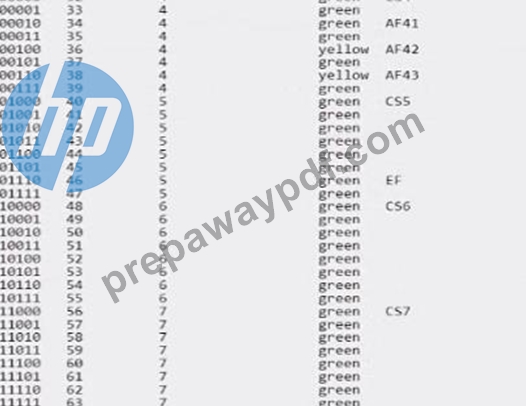
Which strategy will complement this solution to achieve their objective?
- A. edge mark critical UDP Traffic with CSS
- B. edge mark critical UDP traffic with AF42
- C. edge mark lower priority TCP traffic with AF12
- D. edge mark lower priority TCP traffic with AF11
Answer: B
Explanation:
Given that the ACME company's concern is about UDP traffic potentially encountering packet drops due to uplink oversubscription, they need a strategy that prioritizes critical UDP traffic to minimize loss.
Option D,edge mark critical UDP traffic with AF42, is the correct answer. Assured Forwarding (AF) classes provide a way to assign different levels of delivery assurance for IP packets. AF42 is typically used for traffic that requires low latency and low loss, such as voice and video, which often use UDP. Marking critical UDP traffic with AF42 will help ensure that this traffic is treated with higher priority over the network.
Option A (edge mark lower priority TCP traffic with AF12) and Option C (edge mark lower priority TCP traffic with AF11) suggest marking lower priority TCP traffic, which does not directly address the concern for critical UDP traffic.
Option B (edge mark critical UDP Traffic with CS5) suggests using Class Selector 5 for critical UDP traffic, which is also a valid approach but does not match the existing configuration that is focused on Assured Forwarding (AF) classes.
NEW QUESTION # 32
A customer's infrastructure is set up to use both primary and secondary gateway clusters on the SSID profile cased on best practices. Why do they have an equal split of their 120 APs across the primary and secondary gateway clusters?
- A. The primary gateway cluster is a heterogeneous cluster with six nodes.
- B. The primary and secondary gateway clusters are up. but the cluster preemption Is not enabled
- C. The secondary gateway cluster is a homogeneous cluster with six nodes.
- D. The primary and secondary gateway clusters are up. and the cluster preemption is enabled
Answer: B
Explanation:
When cluster preemption is not enabled, access points (APs) will not automatically fail back to the primary gateway cluster once it is up again after having failed over to the secondary. This would result in an equal split of APs across primary and secondary clusters if both clusters are operational. Without preemption, there's no automatic rebalancing of APs back to the primary cluster, leading to the current distribution.
NEW QUESTION # 33
A deployment using AP-635S is connectedto a stack of CX 6300s as shown.
The output of the snow LACPinterfaces shews the following:
What is causing this issue?
- A. Spanning tree and loop protect are enabled on both AP uplink ports.
- B. e0 is connected to a smart rate interface, and e1 is connected to a non-smart rate interface.
- C. Each AP interface is connected to a routed-only interlace on different networks
- D. The AP is configured with LACP active
Answer: D
Explanation:
In an Aruba deployment, if an AP's interfaces show different LACP states, it often indicates a configuration mismatch. If one interface is up and the other is blocked as shown in the output,it's likely due to both interfaces on the AP being set to LACP active mode, which is a correct setting for establishing an LACP channel with Aruba switches like the CX 6300 series.
NEW QUESTION # 34
What is me recommended configuration to ensure link aggregation is consistent in a campus topology using VSX with two aggregation switches and downlinks to access switches?
- A. Use the command "vsx-sync active-gateways" under the VSX context.
- B. Use the command "vsx-sync mclag-interfaces" under the VSX context.
- C. Keep the MTU values at the default setting for GRE and VXLAN communications
- D. Use a custom LACP hash algorithm for improved load Balancing.
Answer: B
Explanation:
When configuring Virtual Switching Extension (VSX) in a campus topology for link aggregation across two aggregation switches, it is important to synchronize Multi-Chassis Link Aggregation Group (MC-LAG) interfaces. The command "vsx-sync mclag-interfaces" ensures that the state and configuration of MC-LAG interfaces are synchronized between the two VSX-linked switches,providing consistent link aggregation and preventing any loops or mismatched configurations that might occur if the interfaces were not in sync.
NEW QUESTION # 35
A Windows device attempts to connect to an 802.1X network but it is not receiving the correct role. TEAP has been configured asthe only authentication method in ClearPass.The wireless configuration is correct.
Exhibit.
What is me mostlikelycause?
- A. The Windows device needs 10 De configured tor TEAP.
- B. ClearPass requires a second authentication method.
- C. 802.1X is not compatible with TEAP in windows device
- D. Only machine authentication should be configured on the Windows device
Answer: A
Explanation:
The issue likely stems from the Windows device not being configured to use TEAP (Tunneled Extensible Authentication Protocol) as specified in the ClearPass configuration. TEAP is an EAP method that encapsulates an inner EAP method for secure authentication. The Windows device must have TEAP enabled and correctly configured in its network settings to authenticate successfully on the network using ClearPass.
NEW QUESTION # 36
Exhibit.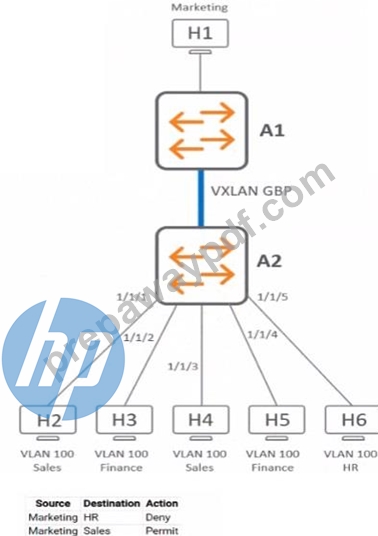
What is me expected behavior for ARP traffic sent from H1?
- A. A2 will send the ARP traffic out of ports 1/1/1-1/1/4.
- B. A2 will drop the ARP traffic.
- C. A2 willflood the ARP traffic out of all interfaces.
- D. A2 willsend the ARP traffic out of ports 1/1/1 and 1/1/3.
Answer: C
Explanation:
In a VXLAN environment, unknown unicast traffic, such as ARP requests from H1, which does not have a specific destination MAC address learned by the switch A2, will be flooded out of all interfaces. This flooding behavior is necessary because A2 needs to ensure that the ARP requestreaches its intended destination, which might be on any of the interfaces. It's a part of the standard behavior of switches to handle ARP traffic when the destination hardware address is unknown.
NEW QUESTION # 37
A network technician racked up two 9240 mobility gateways in a single cluster that will be terminating 1700 APs in a medium-sized branch office Next, the technician cabled the gateways with two SFP28 Direct Attach Copper (DAC) cables, distributed between a two-member core switching stack and powered them up.
What must the network administrator do next regarding the gateway configuration to ensure maximum wired bandwidth utilization?
- A. Disable the spanning tree and allocate unique VLANs to each port.
- B. Map two physical ports to a port channel on each gateway.
- C. Manually set 25Gbps speeds on all ports.
- D. Make an ports trunk interfaces and permit data VLANs
Answer: B
Explanation:
To maximize wired bandwidth utilization, especially when multiple APs are terminating on mobility gateways, it's best practice to aggregate physical ports into a port channel. This provides redundancy and increased bandwidth by combining the throughput of multiple ports.
NEW QUESTION # 38
......
Updated Verified HPE7-A07 dumps Q&As - Pass Guarantee or Full Refund: https://www.prepawaypdf.com/HP/HPE7-A07-practice-exam-dumps.html
HPE7-A07 PDF Questions and Testing Engine With 70 Questions: https://drive.google.com/open?id=1ODhC6DFbgWYssx9t62sJzBw4vQOYiXmU